Drake’s Goes Collegiate

image


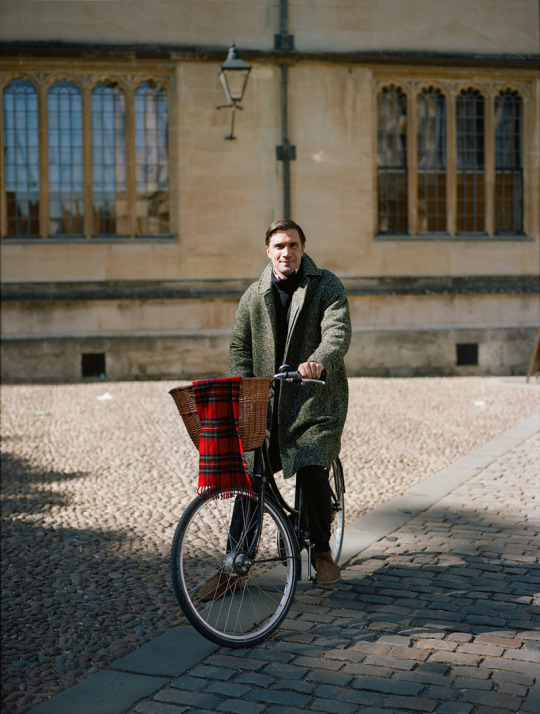
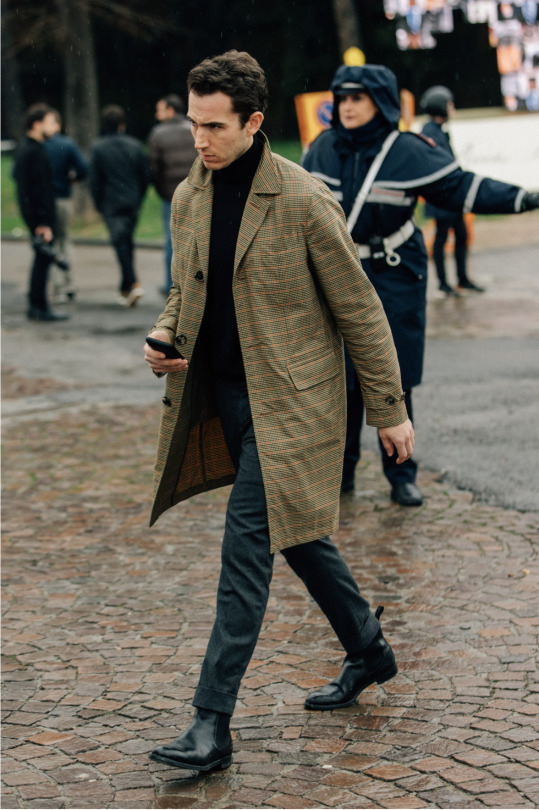
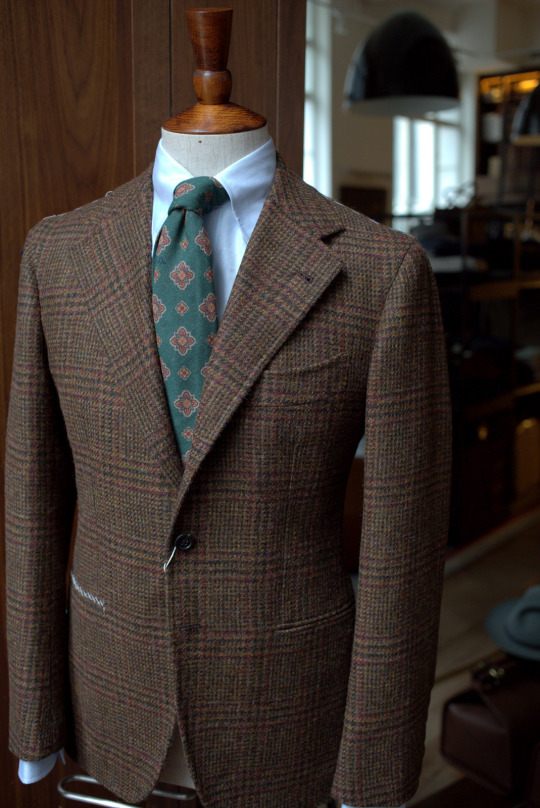
If prep ever makes a comeback, it’ll be because of lookbooks like Drake’s. For this coming fall/ winter season, they shot their collection of brushed Shetlands and tweedy outerwear against the collegiate Gothic architecture of Oxford University. The combination makes the photos look as though they were lifted straight out of Take Ivy. One of Drake’s employees, an Oxford alum who helped put this project together, led the team through his favorite parts of the campus and his old, familiar watering holes. 

Drake’s Creative Director, Michael Hill, doesn’t want you to think this is about Ivy Style, however. “We’ve always been inspired by Ivy clothing, but this isn’t about recreating a look,” he says. “It’s just that we’re close to Oxford and it’s a beautiful setting. Ivy is a style that inspires us greatly – we look back at provenance and history a lot. But this is also very much about doing something right for today, in our own way, and presenting our clothes in a manner that we feel was fun and playful.”

Playful is a good way to describe some of the new items this season. There’s a pocket square decorated with a spinning collage of space-floating astronauts (if you buy a truck-ton of those squares, I imagine they could make for cool wallpaper inside a nursery). I also like the single-stick London Undercover umbrellas that feature an archival print on the underside of the canopy, as well as the brightly colored, Kelim scarves (I bought the blue one). For the bold and fearless, there are block striped Shetlands coming soon. Those look as though Drake’s mashed together all the Shetland yarns they’ve run separately in the past and turned them into a single sweater. David Hockney, a man known for his eccentric embrace of color, would be proud. 

Keep reading
Menswear’s Last Big Moment

image


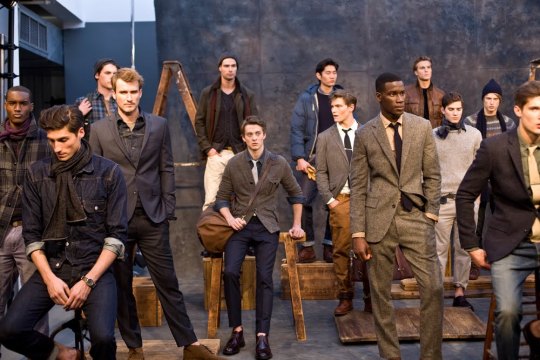
It was April Fool’s Day in 2010 when J. Crew presented their fall/ winter collection at New York City’s Milk Studios. The space, which is normally reserved for photo shoots, is emotionally cold and vaguely industrial. There are concrete floors, exposed brick walls, and sunlight pouring through the massive, factory-like windows. 

Some of the outfits look campy in hindsight, but much of that has to do with the overeager layering – ties peeked out from the tops of crewneck Fair Isle sweaters, suit jackets strained from the bulk of trucker jackets stuffed underneath. But it’s hard to overstate the excitement that surrounded J. Crew’s presentation at the time. After all, the company had just opened their much-anticipated Liquor Store two years ago, which departed from their usual mall set-up and transformed an after-hours watering hole into a menswear-only boutique. Cashmere cardigans were draped over Globetrotter suitcases, rep ties rolled into lowball glasses, and Alden brogues neatly arranged alongside records from The Smiths. Dimly lit rooms were covered in oriental rugs, plush leather chairs, and dark wood paneling. In the corner of one room, a bookshelf stacked with masculine, Strand-issued classics – Kerouac, Hemingway, and Cheever among them – helped lure in men who yearned for a nostalgic past they perhaps never even lived. 

The company’s fall/ winter 2010 presentation was similarly moody. Models were dressed in slimmed-up Donegal suits, raw denim jeans, and waxed cotton field coats. The color palette mostly relied on deep navy blues and stone grays, accented with the occasional bit of burgundy and burnt ochre. And while the studio space was sparsely decorated, you could tell everything was carefully chosen for effect. The models stood on top of distressed wooden shipping pallets and crates. The surrounding mechanical systems were left exposed. A crush painted photographer’s backdrop stood in the background. Even the press in attendance that day was served Dark ‘n Stormy cocktails. 

Keep reading

The Great Uncoupling in Fashion

image


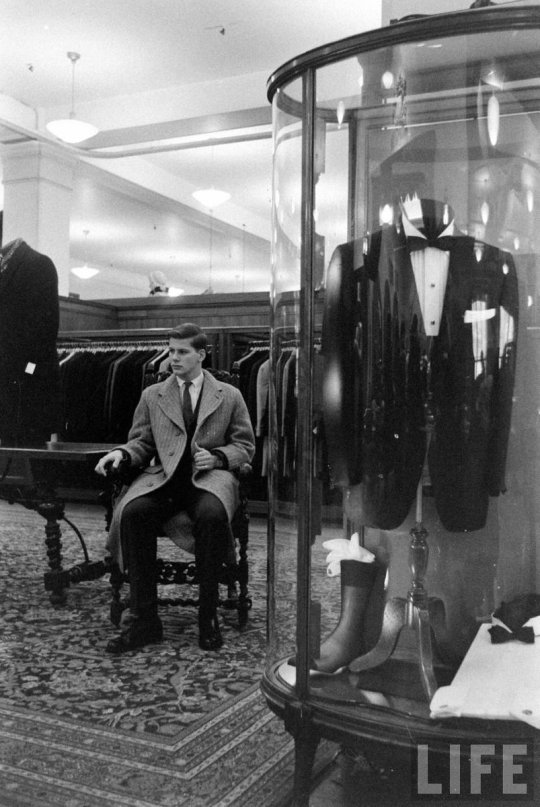
In 1936, the editors of Apparel Arts published “Permanent Modern,” a fourteen-page article introducing their vision for the ideal menswear store. The article spares little in details. Included are elaborate floor plans and descriptions of the materials that should be used for the architecture, fixtures, and display cases. According to the editors, things should look modern, but not “voguish modern,” as you want to catch the customer’s eye, yet also make the place feel inviting. They even specified the lighting and air conditioning systems (two whole pages were dedicated to that). Should the reader want to implement their vision, they included a directory for the contractors, suppliers, and equipment manufacturers who could help with the store’s construction.

The store they imagined was grand – something like a Saks Fifth Avenue, but solely dedicated to men. There were five retail floors, each dedicated to a certain class of items. On the first floor, you had accessories and footwear. Moving up, there were sport, prep, and university clothes; then high-end tailoring; and finally moderately priced attire and boy’s clothing. The basement floor was to be a club lounge with fruitwood furniture and a fully stocked bar. And at the top-most floor, there would be a penthouse restaurant with an open-air dining terrace. Apparel Arts’ editors imagined that the terrace could be converted into a skating rink in the wintertime, which could also double as a stage for showing clothes on live models. 


Keep reading

Finding the Perfect Summer Tee

image


For being such a basic garment, the t-shirt represents so much of our cultural history. It’s just four-panels with a ribbed neck, but within such a simple construction, you can see the shifts in post-war power, as well as the spread of American culture. Next to Levi’s 501s and Brooks Brothers button-downs, no piece of clothing is more quintessentially American or even popular in the world. 

The t-shirt has its roots in Britain, however. It derives from an all-in-one undergarment called the union suit, which was traditionally made from flannel. At some point, the Brits found them to be too warm, so they cut them in half to come up with the two-piece long john set (something men still wear today). The top half of that set eventually morphed into the short-sleeved, finer cotton pullover we think of as a t-shirt. 

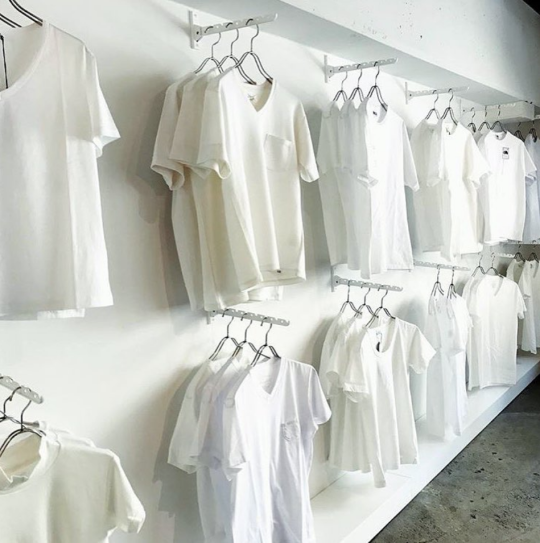
T-shirts were never meant to be worn as outer garments, but they became so in much the same way that chambray shirts, jeans, and other working-class gear entered our day-to-day wardrobes. In the early-20th century, the US Navy picked up the tee to be part of their uniform. They chose white tees because they were cheaper to manufacture, as the yarns didn’t have to be dyed, and the pristine color helped to promote a sense of self-discipline and cleanliness amongst their sailors. Just before the US entered the Second World War, a Sears, Roebuck and Co. advertisement declared: “You needn’t be in the army to have your own personal t-shirt,” suggesting that the garment carried a certain sense of heroism and machismo. 

Keep reading

A Bit of Inspiration for Spring

image


I’m convinced that no one who likes clothes can possibly like spring. The clothes are often less interesting; there’s less opportunity for layering. The cuts reveal more than conceal, and few of us look good naked. Whereas dressing for winter can be something of a paint-by-numbers exercise, dressing for spring is more like trying to solve a puzzle. How do you dress well, but also comfortably? 

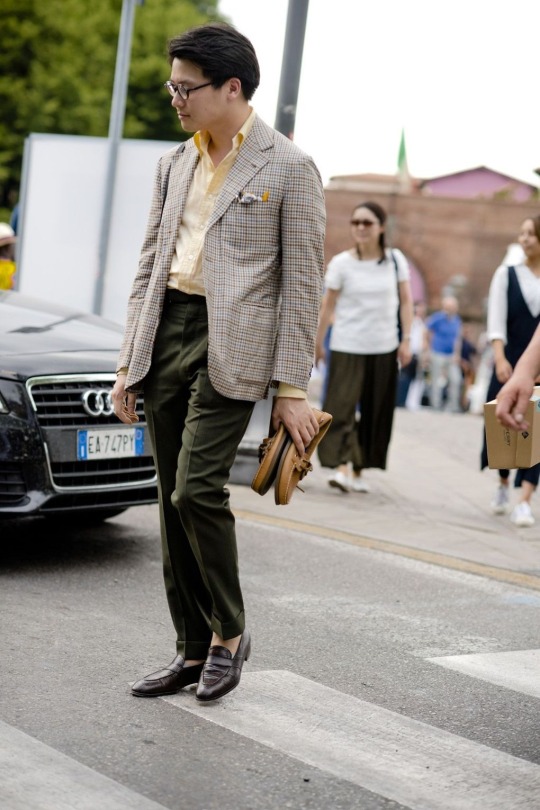
It always takes me a while to switch wardrobes this time of year, but I often go back to the same things – breathable tailoring, button-down shirts, and loafers. For casualwear, it’s usually a field jacket or chore coat, then some raw denim jeans (gotta get those fades). I also like bolder shirts nowadays with unusual collars. If you’re looking for some style inspiration this spring, here are three things I’m really into at the moment. 

Some Spring Tailoring

Keep reading

Dressing for Your Complexion

image


In their guide Perfumes, widely considered the bible on the subject, Luca Turin and Tania Sanchez answer some commonly asked questions about fragrances. One was whether scents change according to the wearer’s personal chemistry. “For a long time, Luca believed the answer to be absolutely no,” writes Sanchez. “And that all assertions to the contrary were marketing ploys designed to make the average person feel uniquely addressed and bonded to the product, as if perfume were like a mood ring or shrink-to-fit jeans, sensitive to the wearer’s medical history, soul, or waistline. There’s something to that; undoubtedly it makes us feel special to sigh and say, ‘I love this perfume because it works fantastically with my chemistry.’” 

Their full answer is a bit more complicated than that – scents do change a little with the wearer’s chemistry, but not really – which is how I feel about the neverending debate about whether you should consider your skin tone when choosing colors. You hear this all the time, especially among men who use bespoke tailors. They, after all, have an infinite number of choices between the different shades of blue. Supposedly, earthy hues work on some men, while others are better off with something warmer. 

Much of this actually comes from Carol Jackson’s 1987 book, Color for Men, which transported 1970s make-up theory for women into men’s wardrobes. For Jackson, people came in four seasonal colors. Wintery men are defined by their olive complexions, dark brown hair, and brown eyes. She said they should avoid lighter colored jackets, such as those in natural camelhair, since they give their skin a yellow cast. Instead, she encouraged them to wear dark suits, white shirts, and dark ties, which she claimed enliven their natural look. 

Keep reading

Five Relatable Style Lessons

image


Even with the explosion of online media nowadays for men’s clothing, it can be a challenge to find good, relatable content for how to wear a coat-and-tie. Much of what’s celebrated online is too aggressively styled for most offices – tightly cut suits, heavily patterned fabrics, and unusual accessories. Great for Instagram and menswear blogs, but less so for the day-to-day grind of most people’s lives. 

Which is why it was such a pleasure for me to talk with Mr. Kazuto Yamaki. He’s the CEO of Sigma, a Japanese manufacturer of camera lenses, flashes, and other photographic accessories. He’s also an exceptionally well-dressed public figure, but so far removed from the world of menswear blogs that I had to try a few times to convince him that I was not, in fact, joking when I said I wanted to interview him about how he dresses. 

Much of what Mr. Yamaki wears will be familiar to anyone who reads this site – softly tailored Italian-influenced suits and sport coats, paired with tastefully designed ties and solid colored dress shirts. Where I think he makes a distinction is that everything looks relatable, something you can wear to most offices today. It’s thoughtfully considered without being obsessive; informed without nit picking. And in being so, it looks more naturally put together. 

Keep reading

Single Open, Double Closed

image


My friend Reginald-Jerome de Mans recently wrote a review on Adolf Loos’ short volume of collected essays, titled Why a Man Should be Well-Dressed. Loos was an influential European architect at the turn of the 20th century, whose main work foreshadowed modernism in architecture and design. In his spare time, he opined on men’s fashion in cantankerous ways. Frankly, I found his book to be one of the worst I’ve read, although RJ feels otherwise (his review is infinitely better than the book itself). That said, I agree with the opening of RJ’s essay: “I love a book whose author dares to assert a viewpoint. In clothing, this means more than simply asserting ‘style is eternal’ or ‘nice clothes are nice,’ as most books on the subject seem to do.” 

So, in that spirit, I’ll dare to assert a viewpoint: I find some coats look better worn open, and others better closed. And to the degree that anything can be generalized, the ones that look better open tend to be single-breasted. Double-breasted coats can be worn either way, but the fullness of the front lends itself to being fastened. This is true of everything from dress outerwear to more causal parkas and leather jackets. 

I mentioned this offhandedly last year on StyleForum and received a ton of pushback. Frankly, I hadn’t even realized that the view could be controversial – that coats don’t always look equally good both ways. That there’s a difference in how things can look when styled, and this is worth considering when choosing what to wear for the day. I find single-breasted coats to be best for cooler autumnal days; double-breasted to be better if you need something very thick and warm for winter. If the weather is so cold that you think you’ll need to keep covered most of the time, a double-breasted overcoat is going to look better than a single-breasted one. 

Keep reading

Five Great End of Season Sales

image


The next week or two are going to be big for end-of-season sales. Some are just starting to roll in, although at least one store (End) is on their second round of markdowns. I’ll be rounding up some of my favorite sales over the next week, but here are five this weekend worth checking out. 

End: The thing to remember about End is that they’re located in the UK, which means that listed prices tend to be about ~20% lower than what you’ll find at most other shops (since they automatically deduct for VAT). Add to that their current 50% off promotion and things become pretty sweet. 

Some of my favorite brands here include Nigel Cabourn, Engineered Garments, Blue Blue JapanBattenwear, and Levi’s Vintage Clothing. Margiela’s German Army Trainers are also on sale, along with a ton of other shoes from Common Projects, Buttero, Spalwart, and Yuketen. For chunky, textured knitwear you can layer under casual coats, check out Howlin by Morrison and SNS Herning. The second is especially good if you have a lot of workwear in your wardrobe, although you’ll want to size up. SNS Herning runs pretty slim. 

Keep reading

A Bit About Tweed

image


There are two often-recited stories for how tweed got its name. The first is that it was originally a misreading of tweel – an old Scottish word for twill – which was supposedly written on an invoice somewhere. How that misreading eventually made it into the more general vernacular, nobody knows, but it’s probably the pithiness of the story that counts. The other guess is that the word tweed refers to how the cloth originally came from the valley of the River Tweed. That, to me, seems like the more likely reason. Many of the ancient names we have for fabrics are derived from the places where the material was often made – cashmere for Kashmir (India), muslin for Mosul (Iraq), worsted for Worstead (England), cambric for Cambrai (France), and the endlessly cited denim for de Nimes (also France). In many ways, the names we have for fabrics today tell a story about earlier waves of globalization. 

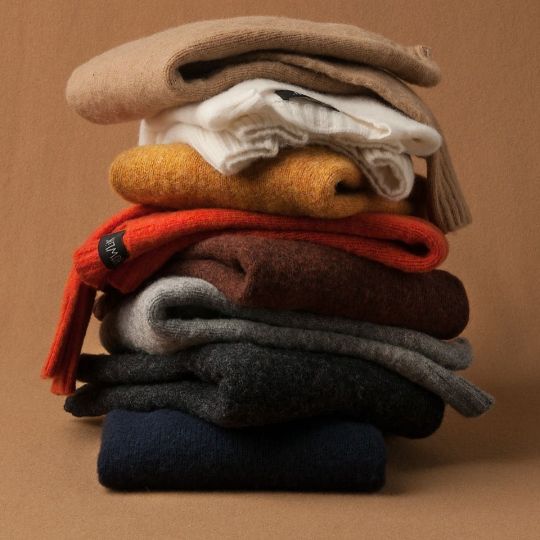
For all the histories we have about tweed, however, few people really know what defines the cloth. It’s one of those “you know it, when you see it” type materials. Prickly in texture and earthy in color, it’s the fabric of fall and winter. It somehow manages to be one of the least and most comfortable materials you can wear. Least in the sense that it’s often too scratchy and rough to be worn against bare skin, which is why it feels and looks better when layered over thicker dress shirts – oxford cloth button downs or brushed cotton flannels. Tweed trousers, if you have occasion to wear them, often need to be fully lined. At the same time, tweed has an undeniably comforting quality to it. It’s hardy and reliable; sturdy and flattering. In a genuinely classic cut, a tweed jacket is something you can wear for the rest of your life. 

The best definition of tweed is a kind of negative definition – a way to understand to cloth by what it is not, rather than what it is. Tweed is one of the oldest, if not the oldest, of British textiles. Before the advent of modern loom technology, European fabrics were stiff and heavy. City fabrics (such as those that would be worn in London) were naturally more refined than country cloths, but they were still more substantial than the Super 100s you’ll find in stores today. Scottish fabrics were rougher still. After the union of the two kingdoms, an economic board was set up to organize and encourage the cottage industries around Scotland. Among those were tweed weavers, who for centuries, made workwear fabrics designed for heavy use out on the countryside.

Keep reading