Summer Tweed and Slubby Oxford

image


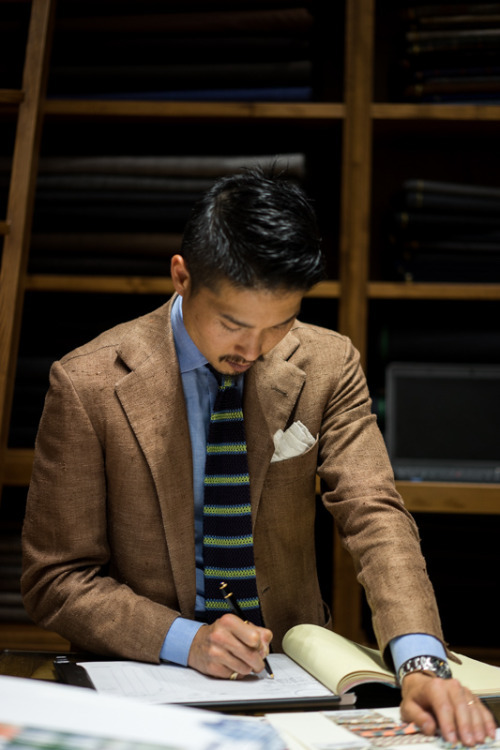
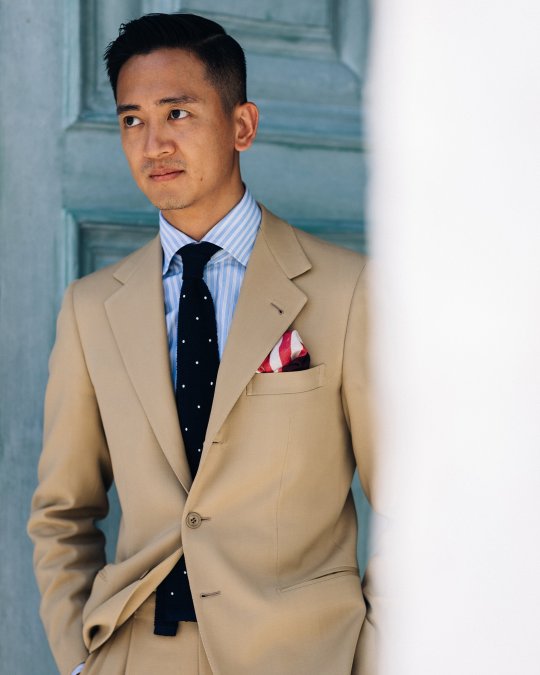
A couple of years ago, after having no success trying to find raw silk jacketing, I organized a custom-run of linen-silk fabric modeled after Taka’s jacket pictured above. The cloth mimics the slubby texture of raw silk jacketings from yesteryear — which are impossible to find today outside of vintage fabric vaults — but it wears cooler and is readily available. I call it summer’s tweed.

I never anticipated it would be such a hit. Since running the fabric, it’s appeared in GQ, The Sartorialist, and Permanent Style. Bespoke shoemaker Nicholas Templeman wore it in a Last Magazine feature. Dionisio D'Alise, the head cutter at Sartoria Formosa, sometimes wears it at fittings. Anderson & Sheppard trained coatmaker Lee Oxley says he loves the cloth. For clients of custom tailors, finding an interesting spring/ summer fabric can be tough. They typically don’t have the same textures or patterns that make fall/ winter clothes so appealing. This one, however, has the visual texture of your favorite tweeds, but is airy enough for spring/ summer weather. 

It’s also a favorite of readers. After having organized multiple custom fabric runs at this point, I’ve received more emails about this one than any other. Those who pre-ordered the fabric have written in to say how much they like their resulting garments. Those who missed out have asked if the cloth will be offered again. So, I’m doing one more run of summer tweed — this time with a special collaboration with Spier & Mackay.

Keep reading

On the Edges of Style

image


In his 1966 essay “The Secret Vice,” originally published in The New York Herald Tribune, the white-clad chronicler of American culture, Tom Wolfe, starts by talking about men who love handmade buttonholes. This was, of course, before surgeon cuffs were standard on ready-to-wear, but the passage will ring true to anyone who’s ever obsessed over the details. 

“Real buttonholes. That’s it!” Wolfe exclaimed. “A man can take his thumb and forefinger and unbutton his sleeve at the wrist because this kind of suit has real buttonholes there. […] Yes! The lid was off, and poor old Ross was already hooked on the secret vice of the Big men in New York: custom tailoring and the mania for the marginal differences that go into it. Practically all the most powerful men in New York, especially on Wall Street, the people in investment houses, banks and law firms, the politicians, especially Brooklyn Democrats, for some reason, outstanding dandies, those fellows, the blue-chip culturati, the major museum directors and publishers, the kind who sit in offices with antique textile shades – practically all of these men are fanatical about the marginal differences that go into custom tailoring.”

The phrase “it’s all about the details” has been exhausted, but in classic men’s tailoring, it’s still true. Suits and sport coats follow a template that’s the result of many generations and skilled hands. But there’s still plenty of room for personal expression. Much has been written about pocket styles (jetted, welted, and patched), lapel shape (peak, notch, straight, and bellied), and closure (single button, two-button, three-roll-two, and the never to be worn hard-three). However, there’s not much online about how the edge of a coat can be finished. It’s a detail that’s easy to forget but can make a surprisingly strong impact on how a garment looks. Here’s a run-through:

Keep reading

How Philo Made Me Love Sandals

image


Before she left her post as the Creative Director of Céline, Phoebe Philo redefined femininity so women could dress in a way that made them feel confident. She is often labeled a minimalist, but that doesn’t tell the whole story. The Philo look is all about loose silhouettes, sumptuous fabrics, and lavish layering. It allows busy women to be women without falling prey to the fashion industry’s infantilizing tendencies. 

“At a time when women are increasingly not just finding their voice but using it, demanding parity and flexing their power, Céline gave them something to wear — or at least to aspire to,” Vanessa Friedman wrote in The New York Times. “Ms. Philo was interested not in what would attract the male gaze, but the female gaze (I can’t tell you how many shows I left with male colleagues who were shaking their heads and saying, ‘I just don’t get it,’ while all the women in the audience were making fantasy shopping lists). And even more important: the grown-up female gaze. In her clothes — deep pile, no-nonsense, swaddling, streamlined — many of them recognized themselves.”

Much has been written of Philo’s legacy, but few recognize the influence she’s exerted on menswear. In the last ten years, she’s been the most influential designer in men’s style, despite never having designed a piece of men’s clothing. Before Demna struck out on his own with Vetements, Philo was popularizing oversized coats designed to be worn with wide-legged pants and chunky sneakers (a distinctly Céline silhouette). She was an early proponent of the return of Stan Smiths, often ending her runway shows with an appearance in the sporty white sneakers. Philo recast Vans slip-ons as a fashion item, making the skate style with chunkier soles and unusual materials. She popularized self-belted pants and pajamas as daywear. And in 2010, Philo sent fur-lined Birkenstocks down the runway, which made the sandal a hit with women. A year later, men started wearing Birks because of how easily they pair with workwear. 

Keep reading

A Modern Dickie Greenleaf Look

image


The Talented Mr. Ripley, the film version and not the book, opens with a brilliantly economical line about clothes. Matt Damon, as the film’s anti-hero Tom Ripley, borrows a Princeton jacket from a friend while working as as a piano player at a party. The Ivy League jacket ends up getting him the attention of a wealthy shipbuilder, who thinks that Tom went to Princeton with his son Dickie. He sends Tom away to Europe, hoping Tom can convince his ne'er-do-well son to come back home from southern Italy. Having left his bleak Manhattan life, however, Tom becomes enraptured by Dickie’s charming dilettante lifestyle. So he strikes up a Faustian bargain and steals it. “If I could just go back … if I could rub everything out … starting with myself, starting with borrowing a jacket,” Tom silently dreams to himself at the beginning of the film. And doesn’t Tom’s line neatly sum up what we all wish for when we purchase a new jacket or pair of shoes? The fantasy that it’ll somehow magically transform our mundane lives? (Well, maybe without the murderous crime.)

The film is important to fashion in other ways. Every summer, men reference Anthony Minghella’s chilling thriller as one of their favorite sources for warm weather style inspiration. The Talented Mr. Ripley captures the feeling of being young and carefree, not unlike the films of French New Wave, but with more of a la dolce vita vibe and touristy idyllic scenes of a sun-drenched 1950s Italy. It’s a hypnotic, voluptuously beautiful film with tons of references to menswear cliches: inherited wealth, Ivy League education, and an impossibly glamourous lifestyle in an Italian seaside town. 

For that Dickie Greenleaf vibe, even if not its literal look, you can turn to Joyce. The relatively new brand offers the same laid-back, vacation style that defines the film. Their clothes are loosely cut, retro-inspired, and pair well with tortoiseshell sunglasses and well-mixed martinis. The company even has the same America-to-Italy backstory. The idea for the brand was first seeded when John Walters, the company’s founder, was working as a product designer in New York. However, it didn’t materialize until Walters visited his girlfriend in Florence, Italy (where they now both live). Today, it’s based out of their Florentine studio, while product fulfillment takes place out of Indian Wells, California. “Stylistically, our online visuals reference a lot of Pink Floyd’s earlier works, as well as some of Alain Delon’s films, such as Purple Noon and The Swimming Pool,” says Walters. “Aside from that, we also get a lot of our style inspiration from traveling.”

Keep reading

END’s Summer Sale Starts

image


END, a contemporary menswear shop based in the UK, always has one of the best end-of-season sales. Since they’re located in Europe, their prices are typically 20% lower than what you’d pay for the same items in the US, thanks to VAT deductions. Which means their end-of-season promotions are even better than what they seem at face value. At the moment, they’re holding their spring/ summer sale, where you can find select items discounted by as much as 60%. Once you account for VAT discounts, however, the sale is actually closer to 68% off. 

END’s online inventory is one of the few that rivals Mr. Porter’s (who, by the way, just dropped prices for the third time and are having a 70% off sale). Which means, your best bet is to browse through the sale selection by filtering for clothing categories and sizes. This way, you can stumble upon things you may not otherwise see. If you’re looking for highlights, here are some things I think are particularly worthwhile. 

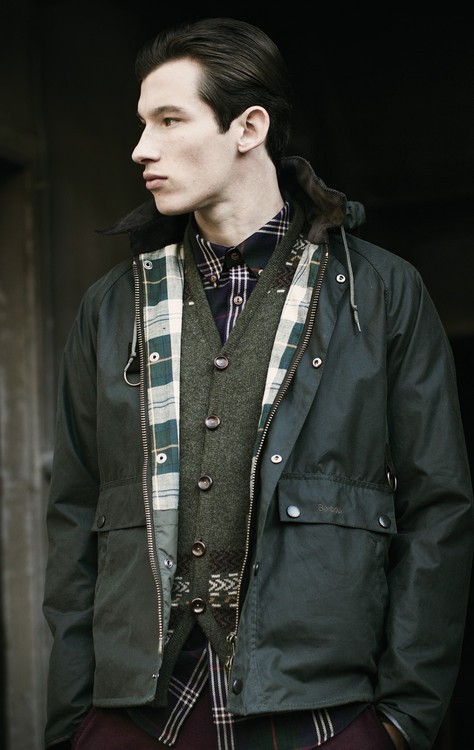
Barbour: If you’re one of the few menswear guys left who doesn’t own a Barbour, END is one of the best places to score a deal. Again, since their prices are already lower than what you’d typically find stateside, their end-of-season promotions make these especially attractive. These days, I mostly wear the waxed cotton Bedale in olive, although the longer Beaufort is better for layering over sport coats. The Liddesdale is also a favorite of many people. It’s an uber affordable, quilted jacket that looks great with jeans and Shetland sweaters. At END, you can find the Liddesdale at a very low $95, while the waxed cotton models start at $209. For sizing advice, check out the Barbour buyer’s guide I wrote for Put This On

Keep reading

Things I’m Excited to Wear This Summer

image


It’s easy to get down on summer clothes. They don’t have the natural appeal of fall and winter wardrobes – there are no plush cashmere knits or prickly tweeds to draw you in, and there are few opportunities to layer. Over the years, however, I’ve come to appreciate how the changing of wardrobes helps mark the passing of time. Summer allows us to wear camp collar shirts, soft suede loafers, and airy materials, such as Tencel and linen. It’s also a good time to reintroduce ourselves to cheerier colors: warm peach, French blue, and sunflower yellow. If you’re looking for ideas on what to wear this season, here are ten things I’m particularly excited about. 

Bold Striped Shirts

White shirts are an all-time classic. During the Middle Ages, being able to wear a fresh linen shirt every day suggested you had wealth and status. White shirts were considered underwear, the first layer against the skin, and were easily soiled during a time of limited hygiene practices. Blue shirts, on the other hand, came much later as part of the uniform of laborers, sailors, and even prisoners.

Keep reading

The Joy of Fountain Pens

image


When UC Berkeley professor David Eisenbud visited the University of Tokyo some years ago, one of the Japanese professors told him they have better chalk than their American counterparts. “Oh go on, chalk is chalk,” Eisenbud said incredulously. As it turns out, chalk isn’t just chalk. Many of the brightest mathematicians on the planet believe that Hagoromo Fulltouch is mystical in some way. They say it can’t break. They say it glows on the board. They say it inspires and invigors, while also leaving a cleaner, smoother, and more elegant line. “The legend is that it’s impossible to write a false theorem with this chalk,” says Eisenbud, now a convert.

At first, Hagoromo Fulltouch was only available in Japan, which meant if you wanted a stick, you had to proxy it like streetwear. That was until an Amazon distributor started selling Fulltouch to American professors, which is how the chalk wound up in so many U.S. math departments. Five years ago, however, Hagoromo president Takayasu Watanabe announced the company would be halting production in February of 2015, and stop sales altogether the following month. American mathematicians went crazy. They bought, hoarded, and stockpiled as much of the stuff as they could. Eisenbud estimates he has a ten-year supply at home.

Soon after the company shuttered, a secondary market emerged. “I didn’t want to become a chalk dealer,” laughs Max Lieblich, a math professor at the University of Washington. “But I did like the idea that I could be the ‘first stick is free’ chalk dealer in my department.” Those who stockpiled the chalk sold sticks to their chalk-less colleagues, presumably at hiked up prices, much like rare and coveted Nikes. But the market came crashing down a year later when a South Korean company bought rights to the formula and started reproducing the “Rolls Royce of chalk” faithfully. Today, you buy Hagoromo Fulltouch in white and a variety of colors on Amazon.

Keep reading

It’s Easy Being Green

image


You’ve heard the phrase a million times: “You can have any color as long as it’s black.” In his autobiography My Life & Work, Henry Ford claimed he told his management team in 1909 that, going forward, his best-selling Model T would only be available in one color. But for the first few years of its production, from 1908 to 1913, it wasn’t available in black at all, but rather bullet gray, dark green, midnight blue, and fire engine red. The all-black change didn’t happen until 1914, with the outbreak of World War One. Ford switched to black because of the paint’s low cost, durability, and faster drying time. Paint choices were determined by the chemical industry, which at the time was affected by dye shortages and new nitrocellulose lacquer technologies. The decision had more to do with economics than style.

Cars back then were painted using a process called japanning, which today would be known as baked enamel. “It was first used in the mid-1800s for decorative items imported into America,” says Model T restorer Guy Zaninovich. “A piano has a shiny black surface that almost looks like plastic rather than paint because it’s done with the japanning process. It leaves a tough and durable surface.” Japanning also dries quickly, which was important to the efficiency-obsessed Ford. His plants produced as many as 300,000 cars per year, at a time when competing automakers had a combined production of about 280,000 cars, so shaving minutes off each car’s production time was critical. The catch? Japanning was only available in black. “If japanning worked in hot pink, all Model T’s would have been hot pink,” Zaninovich joked. 

The history of the Model T is just one of the many strange stories of why certain things come in specific colors. Suits, for example, mainly come in navy and gray because, back in the Regency period, men wore navy coats with cream-colored breeches. Regency blue eventually gave way to Victorian black by the mid-19th century, but the norm for wearing contrasting trousers remained. The suit, as defined by a coat worn with matching trousers, wasn’t typical in London until the end of the 19th century. Until then, the suit was only worn for sport and leisure, mostly in the countrysides. No proper gentleman would ever wear it to town.

Keep reading

Excited to Wear This Spring

image

Spring is the season for songbirds and meaningless baseball, cool mornings and warm afternoons, but for people who love clothes, it’s also the worst time of the year. Spring clothes are often less interesting. There fewer opportunities to layer. The cuts reveal more than conceal, and few of us look good naked. Whereas dressing for winter can be a paint-by-numbers exercise, dressing for spring is more like trying to solve a puzzle. How do you dress well, but also comfortably?

It always takes me a while to switch wardrobes this time of year, but I often go back to the same things – breathable tailoring, button-down shirts, and loafers. For casualwear, it’s usually a workwear styled jacket and some raw denim jeans (gotta get those fades). I also like bolder shirts nowadays with unusual collars, and have even been embracing things such as graphic tees. If you’re looking for some early spring inspiration, here are some things I’ve been thinking about.

MY KIND OF FUN SHIRT

Keep reading

The Best Prints of the Season

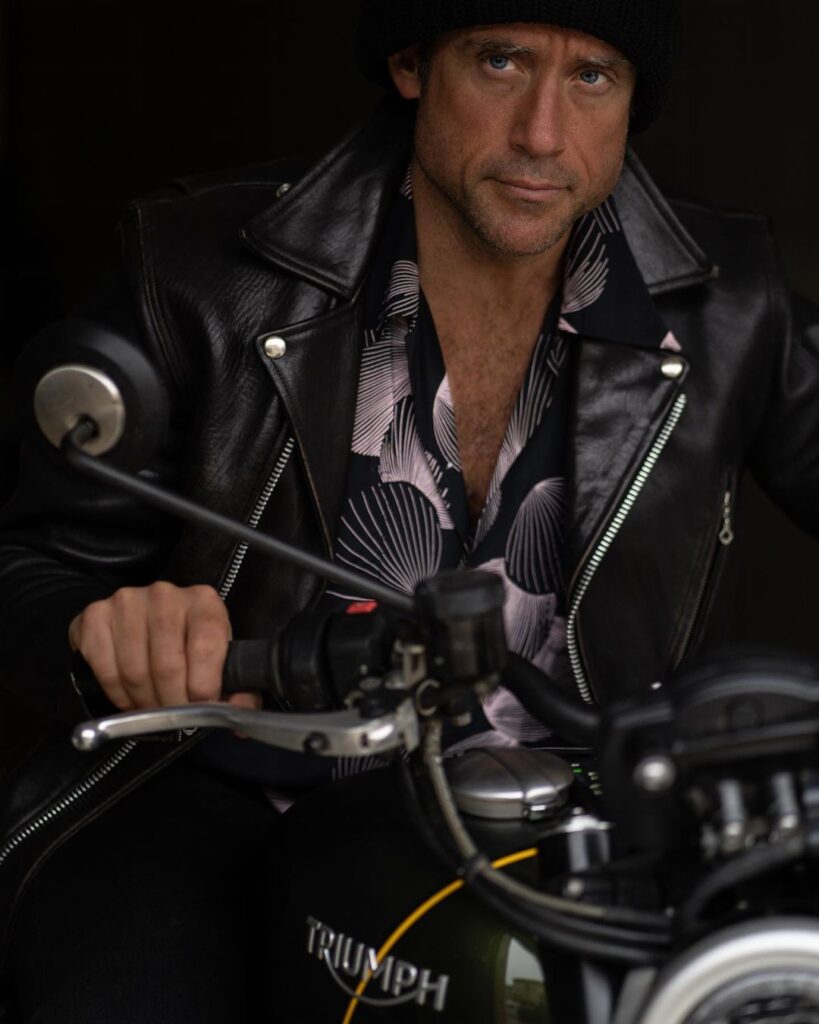
Men’s style has been primarily confined to simple lines and sober colors since the days of Regency England, but the summer shirt remains one of the last places where you can still wear a bit of pattern and color. In the 1960s, shortly after Hawaii attained US statehood, mainland Americans wore Aloha shirts for the freedom they represented: a warm island life far away from cold factory work and steel offices, where you could be serenaded by ocean waves and fall asleep on the beach. Somewhere along the way, the dream got corrupted. Colorful, printed shirts, particularly those in oversized, short-sleeved form, have become the style signature of guys with outsized personalities: golfing uncles, Guy Fieri, and Smashmouth fans. 

In the last few years, the summer print has started to come back in earnest. Luxury brands such as Prada and Saint Laurent have used them in their darker-themed runway collections. A little sleazier and more LA-inspired, these feel more like Scarface than “Margaritaville.” There are also upbeat designs that take inspiration from Hawaiian history, surf culture, mid-century design, leisure activities, and resort wear. For some, these outlandish shirts are little more than wearable postcards. For me, they’re a sign of positivity. I’m dreaming of wearing a printed shirt this summer with shorts and huaraches, like Donald Glover above, while listening to The Delegation’s “Oh Honey,” Kansas City Express’ “This is the Place,” and Japanese jazz trombonist Hiroshi Suzuki’s “Romance” (the last song, off the artist’s 1975 album Cat, is so gooood). 

I mostly like printed shirts this time of year because they offer an interesting alternative to the pique cotton polo. A bolder shirt pushes an outfit away from business casual territory; it adds visual interest. And while I still like crisp white linens and light-blue oxford-cloth button-downs, it helps to have some bolder prints for the weekend. From retro to contemporary, here are the best prints I’ve seen this season: 

Keep reading