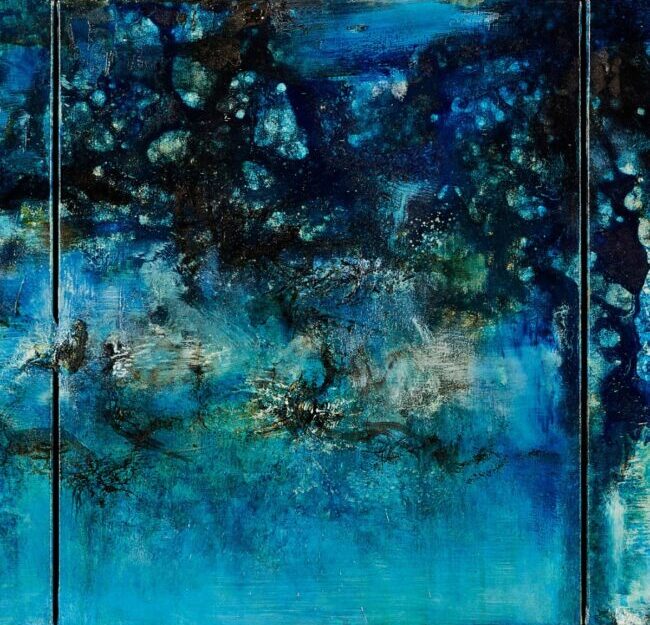
At the Sotheby’s auction house in Hong Kong, a man in a dark blue suit shouted into a microphone as hands kept rising, pushing the price of Zao Wou-Ki’s triptych masterpiece, Juin-Octobre 1985, ever higher. Initially commissioned by I.M. Pei for his Raffles City complex in downtown Singapore, the painting represents the artist’s “Infinity Period.” Across three giant canvases, warm hues of peach, saffron, and lilac silently danced and exploded along a horizontal axis, giving the viewer a sense of the cosmos. In 2005, the painting was taken down from its Raffles City location and sold to a Taiwanese art collector. Then in October 2018, it appeared at this port-city auction house. That night, as arms flew up — many sheathed in silky worsteds, black lambskins, and gauzy blouses — the price kept climbing. By the time the hammer fell, the price for this marquee piece had landed at a staggering HK$450 million (US$65 million), setting a new record for an art piece auctioned in Hong Kong.
Born in Beijing in 1920, Zao was the scion of a prosperous family. His father was a well-heeled banker; his grandfather held the title xiù cai, which signaled a certain level of success in Imperial China’s civil service examination. Zao’s family encouraged him to follow in his father’s footsteps and pursue finance, but he had artistic ambitions. As a teen, Zao spent his days clipping images out of European and American art magazines, and pleading with his family to allow him to attend art school. His parents relented, but not without requiring him to at least get a classical Chinese education. So in 1935, a young Zao went to to the China Academy of Art, where he spent six years studying calligraphic ink painting. Upon graduating, he spent a few more years there as a teacher. Then in 1947, as the Chinese revolution drew nigh, Zao hopped on a plane and flew to Paris, intending to pursue two more years of art education.
Even as Paris was lifting itself out of the wreckage of the Second World War, the city had a vibrant and flourishing art scene. Much of this was thanks to the diversity already present in the French capital. Before the war, Paris attracted talented sculptors, painters, and printmakers from around the world. Many of these immigrants were young Jewish men who resettled on the Left Bank of Paris, where artists, writers, and philosophers gathered in cafes, salons, and galleries. Such artists included the great Amedeo Modigliani (an Italian painter known for his sleek and beautiful portraits), Marc Chagall (a Russian-French pioneer of modernism), and Chaïm Soutine (a tailor’s son whose impressionist portrait of a woman has since become a symbol of democratic protest in his home country of Belarus).
Keep reading