The Slow Death of Glamour

About fifteen years ago, some friends and I took a train to go shopping in San Francisco. One of my friends had just been invited to a wedding, and while we were all graduate students at the time and had very little money, she was determined to buy something beautiful for the occasion. So we headed downtown to Barneys.

Until then, I had never been to Barneys. I remember walking into the building and feeling overwhelmed by the store’s expansiveness and glossy emporium feel. There are six main floors for men’s and women’s collections. Each floor is neatly arranged but also packed with the kind of clothes, bags, and perfumes that most people have only heard of through magazines. Menswear is on the two top-most floors: there’s one for designer and another for tailoring. Here, you’ll find racks of Italian sport coats made from plush cashmere-blend hopsacks and silky windowpane patterns. There are dolefully constructed Rick Owens leather jackets and Thom Browne sweatsuits that are so expensive, they suggest you loot your own country. Near the rows of crystal-weave Charvet ties are the European-made leather bags, which I imagine are sold to men who jet around the world. The whole store felt very glamorous.

Two weeks ago, Barneys filed for Chapter 11 bankruptcy. They announced that they’ll be closing all but five of their 22 locations — the San Francisco store being one of the few that will be spared, along with their Madison Avenue flagship and the Chelsea store that opened three years ago around the block from their original location. If Barneys shutters, it will be the highest-profile victim of the current retail downturn. Some blame the company’s woes on online competition and skyrocketing rents (their Madison Avenue store’s rent nearly doubled to $30 million in January, which the company cited as a significant reason for their bankruptcy). But I can’t help but wonder this isn’t a sign that the once blinding and wonderous shine of glamour is starting to dull.

Keep reading

Summer Tweed and Slubby Oxford

image


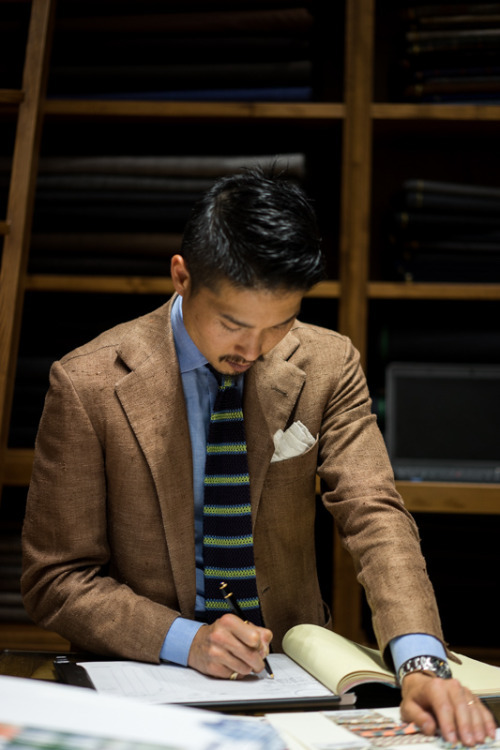
A couple of years ago, after having no success trying to find raw silk jacketing, I organized a custom-run of linen-silk fabric modeled after Taka’s jacket pictured above. The cloth mimics the slubby texture of raw silk jacketings from yesteryear — which are impossible to find today outside of vintage fabric vaults — but it wears cooler and is readily available. I call it summer’s tweed.

I never anticipated it would be such a hit. Since running the fabric, it’s appeared in GQ, The Sartorialist, and Permanent Style. Bespoke shoemaker Nicholas Templeman wore it in a Last Magazine feature. Dionisio D'Alise, the head cutter at Sartoria Formosa, sometimes wears it at fittings. Anderson & Sheppard trained coatmaker Lee Oxley says he loves the cloth. For clients of custom tailors, finding an interesting spring/ summer fabric can be tough. They typically don’t have the same textures or patterns that make fall/ winter clothes so appealing. This one, however, has the visual texture of your favorite tweeds, but is airy enough for spring/ summer weather. 

It’s also a favorite of readers. After having organized multiple custom fabric runs at this point, I’ve received more emails about this one than any other. Those who pre-ordered the fabric have written in to say how much they like their resulting garments. Those who missed out have asked if the cloth will be offered again. So, I’m doing one more run of summer tweed — this time with a special collaboration with Spier & Mackay.

Keep reading

A Modern Dickie Greenleaf Look

image


The Talented Mr. Ripley, the film version and not the book, opens with a brilliantly economical line about clothes. Matt Damon, as the film’s anti-hero Tom Ripley, borrows a Princeton jacket from a friend while working as as a piano player at a party. The Ivy League jacket ends up getting him the attention of a wealthy shipbuilder, who thinks that Tom went to Princeton with his son Dickie. He sends Tom away to Europe, hoping Tom can convince his ne'er-do-well son to come back home from southern Italy. Having left his bleak Manhattan life, however, Tom becomes enraptured by Dickie’s charming dilettante lifestyle. So he strikes up a Faustian bargain and steals it. “If I could just go back … if I could rub everything out … starting with myself, starting with borrowing a jacket,” Tom silently dreams to himself at the beginning of the film. And doesn’t Tom’s line neatly sum up what we all wish for when we purchase a new jacket or pair of shoes? The fantasy that it’ll somehow magically transform our mundane lives? (Well, maybe without the murderous crime.)

The film is important to fashion in other ways. Every summer, men reference Anthony Minghella’s chilling thriller as one of their favorite sources for warm weather style inspiration. The Talented Mr. Ripley captures the feeling of being young and carefree, not unlike the films of French New Wave, but with more of a la dolce vita vibe and touristy idyllic scenes of a sun-drenched 1950s Italy. It’s a hypnotic, voluptuously beautiful film with tons of references to menswear cliches: inherited wealth, Ivy League education, and an impossibly glamourous lifestyle in an Italian seaside town. 

For that Dickie Greenleaf vibe, even if not its literal look, you can turn to Joyce. The relatively new brand offers the same laid-back, vacation style that defines the film. Their clothes are loosely cut, retro-inspired, and pair well with tortoiseshell sunglasses and well-mixed martinis. The company even has the same America-to-Italy backstory. The idea for the brand was first seeded when John Walters, the company’s founder, was working as a product designer in New York. However, it didn’t materialize until Walters visited his girlfriend in Florence, Italy (where they now both live). Today, it’s based out of their Florentine studio, while product fulfillment takes place out of Indian Wells, California. “Stylistically, our online visuals reference a lot of Pink Floyd’s earlier works, as well as some of Alain Delon’s films, such as Purple Noon and The Swimming Pool,” says Walters. “Aside from that, we also get a lot of our style inspiration from traveling.”

Keep reading

No Man Walks Alone Starts Sale

image


It’s that time of year when I post a spat of seasonal sales. The third big one started this morning: No Man Walks Alone, where you can find select items discounted by as much as 40% off. Their sale is one of my favorites for two reasons. The first is that I get to post a photo of the shop’s founder, Greg Lellouche, and note that he is, in fact, walking alone. The second is the shop’s selection. While No Man Walks Alone is a sponsor on this site, they’re also one of my favorite online retailers. Along with some excellent tailoring, they also carry Japanese workwear, contemporary casual, and a bit of the avant-garde.

The selection here is big, but not massive. It’s reasonably easy to scroll through the entire sale selection to see if there’s anything you want, but No Man Walks Alone also has filters on their site so you can narrow in on sizes, colors, and brands. Some of my favorite makers here include Sartoria Formosa, Drake’s, and Kaptain Sunshine. If you’re looking for highlights, here are ten things that I think are notable.

Valstar’s Plaid Wool-Alpaca Topcoat

Keep reading

END’s Summer Sale Starts

image


END, a contemporary menswear shop based in the UK, always has one of the best end-of-season sales. Since they’re located in Europe, their prices are typically 20% lower than what you’d pay for the same items in the US, thanks to VAT deductions. Which means their end-of-season promotions are even better than what they seem at face value. At the moment, they’re holding their spring/ summer sale, where you can find select items discounted by as much as 60%. Once you account for VAT discounts, however, the sale is actually closer to 68% off. 

END’s online inventory is one of the few that rivals Mr. Porter’s (who, by the way, just dropped prices for the third time and are having a 70% off sale). Which means, your best bet is to browse through the sale selection by filtering for clothing categories and sizes. This way, you can stumble upon things you may not otherwise see. If you’re looking for highlights, here are some things I think are particularly worthwhile. 

Barbour: If you’re one of the few menswear guys left who doesn’t own a Barbour, END is one of the best places to score a deal. Again, since their prices are already lower than what you’d typically find stateside, their end-of-season promotions make these especially attractive. These days, I mostly wear the waxed cotton Bedale in olive, although the longer Beaufort is better for layering over sport coats. The Liddesdale is also a favorite of many people. It’s an uber affordable, quilted jacket that looks great with jeans and Shetland sweaters. At END, you can find the Liddesdale at a very low $95, while the waxed cotton models start at $209. For sizing advice, check out the Barbour buyer’s guide I wrote for Put This On

Keep reading

Incomparable Lightness of Being Ugly

image


In The New York Times last month, writer Megan Nolan asked the simple question: why do we all have to be beautiful? As a young girl growing up in Ireland, Nolan wanted to be beautiful so badly, she could taste it (“it tasted like blood”). She didn’t want to be cute or pretty. She didn’t want to be more desirable to men. She wanted to be beautiful because it’s harder to make beautiful people look foolish. Their lives are always well-ordered and they never feel embarrassed. And like all teens, Nolan often felt embarrassed.

Nolan’s hard, painful desire to look beautiful has stayed with her most of her life, but she asks at the end of her essay whether today’s inclusive message of beauty — where we’re told everyone is, in fact, beautiful — does more harm than good. “I tried to love myself as I got older, tried to look with clear eyes at my physical flaws and not just accept but admire them. I tried to believe that, actually, I was beautiful, because everyone was, not just the chosen few,” she writes. “I tried forcing myself to concede this, through a fake smile and gritted teeth. I’ve said it aloud, as advised by body-confidence self-help gurus, while looking at myself naked. It’s always felt absurd. […] Wouldn’t it be freeing to admit that most people are not beautiful? What if we stopped prioritizing pleasing aesthetics above so much else? I wonder what it would be like to grow up in a world where being beautiful is not seen as a necessity, but instead a nice thing some people are born with and some people aren’t, like a talent for swimming, or playing the piano. Everyone is beautiful, we’re told. But why should we have to be?”

Men don’t face nearly the same pressures as women to look attractive. We have other ways of climbing up the social ladder — humor, wealth, and even a reputation for violence. This masculine advantage is well-captured in Biggie’s “One More Chance,” where he raps: “Heartthrob never, black and ugly as ever/ However, I stay Coogi down to the socks/ Rings and watch filled with rocks/ And my jam knocks.” As Ta-Nehisi Coates writes in The Atlantic, the word “however” has never been used to greater effect. “There was no ‘however’ for a girl deemed ‘black and ugly,” he writes. “There were no female analogues to Biggie. ‘However’ was a bright line dividing the limited social rights of women from the relatively expansive social rights of men.”

Keep reading

It’s Easy Being Green

image


You’ve heard the phrase a million times: “You can have any color as long as it’s black.” In his autobiography My Life & Work, Henry Ford claimed he told his management team in 1909 that, going forward, his best-selling Model T would only be available in one color. But for the first few years of its production, from 1908 to 1913, it wasn’t available in black at all, but rather bullet gray, dark green, midnight blue, and fire engine red. The all-black change didn’t happen until 1914, with the outbreak of World War One. Ford switched to black because of the paint’s low cost, durability, and faster drying time. Paint choices were determined by the chemical industry, which at the time was affected by dye shortages and new nitrocellulose lacquer technologies. The decision had more to do with economics than style.

Cars back then were painted using a process called japanning, which today would be known as baked enamel. “It was first used in the mid-1800s for decorative items imported into America,” says Model T restorer Guy Zaninovich. “A piano has a shiny black surface that almost looks like plastic rather than paint because it’s done with the japanning process. It leaves a tough and durable surface.” Japanning also dries quickly, which was important to the efficiency-obsessed Ford. His plants produced as many as 300,000 cars per year, at a time when competing automakers had a combined production of about 280,000 cars, so shaving minutes off each car’s production time was critical. The catch? Japanning was only available in black. “If japanning worked in hot pink, all Model T’s would have been hot pink,” Zaninovich joked. 

The history of the Model T is just one of the many strange stories of why certain things come in specific colors. Suits, for example, mainly come in navy and gray because, back in the Regency period, men wore navy coats with cream-colored breeches. Regency blue eventually gave way to Victorian black by the mid-19th century, but the norm for wearing contrasting trousers remained. The suit, as defined by a coat worn with matching trousers, wasn’t typical in London until the end of the 19th century. Until then, the suit was only worn for sport and leisure, mostly in the countrysides. No proper gentleman would ever wear it to town.

Keep reading

Making Bespoke Casual Shoes

image


John Lobb’s shoemaking workshop on St. James of London looks like an old university office. Harsh florescent bulbs hang overhead, casting light upon leather armchairs, glass showcases, and dusty objects left untouched. The shop feels fusty and cluttered. Thick, ancient ledgers stretch across the shelves that run high and around the back offices. Racks are covered deep with wooden lasts, which are arranged in no apparent order. In a BBC documentary, Brian Dobbs, who wrote a book on the firm’s history fifty years ago, climbs a stepladder to retrieve one of Lobb’s archives. “Well the shelves weren’t arranged for historians, that’s for sure,” he says wryly. “This is less archaeology and more mountaineering.” As he tries to take the book down, a bundle of wood tumbles off the shelf below, clanking onto the floor.

John Lobb’s building is much larger that one might imagine for a shoemaking firm that produces 500 pairs of bespoke shoes per year. Before the 1950s, this space housed a Rolls Royce dealership. Towards the back, a lift carried fancy cars up and down between the floors for visitors in the showroom. The Lobb family moved in after their old premises were destroyed during the Second World War. Today, lastmakers on the ground floor carve made-to-measure lasts from roughly turned blocks, and three flights down lead to additional workrooms. The shop is big and somewhat quiet, animating Thomas Caryle’s observation that “a man cannot make a pair of shoes rightly unless he does it in a devout manner.”

If you walk down those stairs today, you’ll be flanked by stacks of shoeboxes, each containing a pair of handmade shoes. Some of those are customers’ orders ready to be collected; others are apprentice projects; and others still are forgotten shoes left unclaimed. For whatever reason, whether sudden death or unforeseen poverty or simple forgetfulness, many people fail to claim their shoes after ordering. On the upside, if you can make it to John Lobb’s workshop in London, that means you can purchase bespoke shoes – made to someone else’s measurements – at half price. Nicholas Templeman, who worked as a lastmaker at John Lobb for seven years before starting his own bespoke shoemaking firm, used to fetch those shoes for people hoping to test their fortunes. “To be honest, it rarely works out,” he says. “It’s not like pulling a pair of ready-to-wear shoes off a shelf and trying a size 8. These are all made for someone, so all their idiosyncrasies are built into their last. Every now and again, however, someone gets lucky.”

Keep reading

The Color of Roussillon, France

In August of 1942, not long after Germany took over Paris, Samuel Beckett and his companion (later wife) Suzanne Deschevaux fled their apartment in the French capital. The pair had been working in a Resistance cell known as Gloria, where they translated Axis documents and relayed information about troop movements for Allied powers. The info was coded into microfilm, hidden in candy boxes and slipped into toothpaste tubes, and then passed along through a chain of Gloria members, with each person reporting to the next in line, until the message reached Allied headquarters in London. 

That year, however, Gloria was betrayed by Robert Alesch, a Catholic priest and double agent who sold out hundreds of Resistance agents for his own financial gain. As a result, the Gestapo went around the Paris rounding up Gloria members and other anti-Nazi agents. One of the people arrested was Alfred Péron, a Jewish writer and Beckett’s closest French friend. He was interrogated and eventually deported to one of the most notorious concentration camps, Mauthausen on the Danube River. All categories of prisoners here, from Jews to gays to political opponents, were starved, beaten, used for medical experiments, and subjected to slave labor in the local stone quarries. Péron survived until the end of the war, but tragically died two days after the camp’s liberation in 1945.

In researching for Beckett’s biography, James Knowlson interviewed the extraordinary Germaine Tillion, one of the first Gloria members to be betrayed by Alesch. She was involved with one of the earliest underground organizations of the French Resistance, the Musée de l’Homme, and many of her friends had been executed by Nazis. Knowlson writes of the interview at The Independent:

Keep reading

On Nostalgia and Raincoats

image


Before nostalgia was considered sweet sentimentality, it was thought of as a mental disorder similar to paranoia. In the late-17th century, a medical student named Johannes Hofer coined the term to describe a set of peculiar anxieties he observed in Swiss mercenaries fighting abroad. Symptoms included melancholy, loss of appetite, and an intense longing for bygone times. Initially, nostalgia – from the Greek nostos, meaning homecoming, and algos, meaning pain – was mostly associated with soldiers. The Swiss military even forbade the playing of a particular milking song, Khue-Reyen, for fear that it would lead to desertion or suicide. But soon doctors found other people afflicted with the mania: newly arrived immigrants, children sent off to the countryside for nursing, and women who were forced into domestic servitude. 

Until the turn of the 20th century, the Western medical community came up with all sorts of strange remedial measures for nostalgia. Among the many dubious cures were using leeches, purging stomachs, and even shaming the condition out of patients. During the American Civil War, a military doctor named Theodore Calhoun thought nostalgia was a symptom of the weak-willed and unmanly. In a paper titled “Nostalgia as a Disease of Field Service,” which was read before a medical society, he maintained that “battle is to be considered the great curative agent of nostalgia in the field,” for men would find themselves with a clearer mind after having survived an onslaught. In her book Homesickness: An American History, Susan J. Matt recalls this passage from Calhoun’s stunning lecture, where he recommends public ridicule as a cure:

Any influence that will tend to render the patient more manly will exercise a curative power. In boarding schools, as perhaps many of us remember, ridicule is wholly relied upon and will often be found effective in camp. Unless the disease affects a number of the same organization, as in the case narrated above [Dr. Calhoun is referring to a case in which there is something of an epidemic of nostalgia in a particular regiment – where “nearly all who died were farmers” – before he came to its rescue], the patient can often be laughed out of it by his comrades, or reasoned out of it by appeals to his manhood.

Keep reading