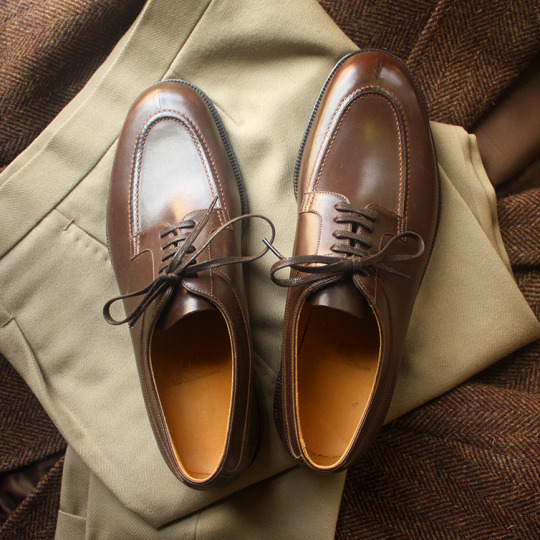
The Sophisticated Black Tassel
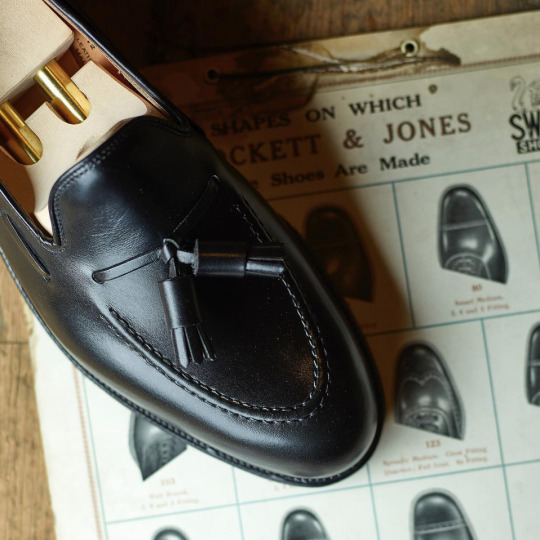
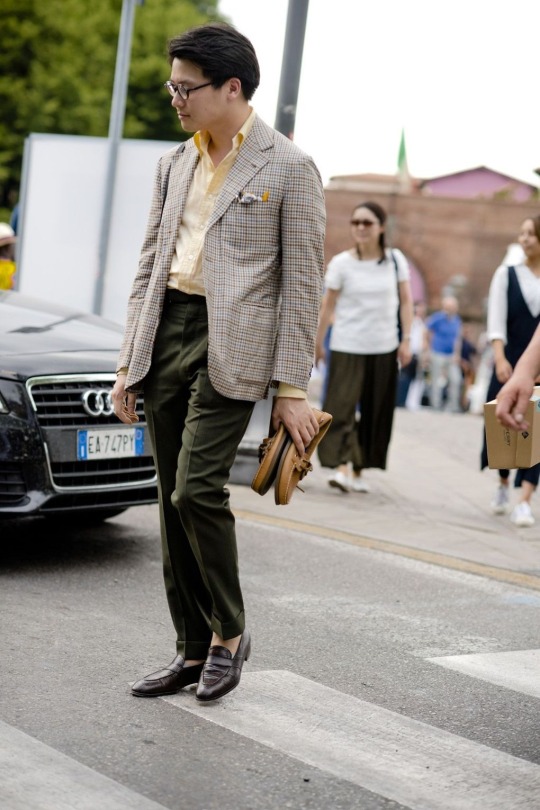
Hidden in the history of the tassel loafer is the story of why men’s dress has become increasingly casual with each passing generation. In the post-war period of the late-1940s, right when tweed jackets and Shetland sweaters dominated prep schools and Ivy League campuses, debonair actor Paul Lukas came back from Europe with a pair of oxfords. Their laces had little fringed tassels at the end, which Lukas thought made them look jauntier. So he took them to a couple of custom shoemakers to see if they could make something similar, and they in turn took the job to Alden. The company’s president at the time, Arthur Tarlow, came up with tassel loafers. That makes Alden’s model the original, and Paul Lukas the first man to wear this style.
Alden’s tassel loafers were an instant success, but they didn’t exist in a vacuum. If you flip through any men’s clothing catalog from this period, you’ll see how much the idea of comfort had already supplanted Edwardian norms of propriety. Instead of high-button dress boots and gaiters, American clothiers were selling low-cut shoes such as white buckskins, brown oxfords, and canvas tennis shoes with rubber soles. In his 1982 Town & Country essay on loafers, which was later collected in his 1985 book Elegance, Bruce Boyer wrote: “To see these newer low-cut shoes side-by-side in the [1915] Brooks catalogue with the then more traditional higher-cut shoes is to realize immediately that back in 1915 the tide was unquestionably turning – had already turned in reality – and that men were allowing themselves more comfort in their dress. Heavy suits and boots, stiff collars, and high hats were all on the way out. Lightweight tweeds and flannels, button-down shirts and soft golf caps, Shetland sweaters and white bucks, had arrived.” The only thing missing from those 1915 catalogs were loafers, which were “the logical extension of comfortable and casual dress that marks the current century.”
Tassel loafers were the norm by the 1960s, worn to business offices and government buildings alike, and favored by college graduates who wanted something dressier than their school-day pennies. But the tide turned again in the 1990s, when the style became a synecdoche for the country-club set and dishonest lawyers. In an all-too-often-cited New York Times article, Neil Lewis once reported that the term “tasseled loafer” was not just a way to describe a simple slip-on anymore, it was a political epithet:
Keep reading