The Last of Arnys’ Ties

image


My friend Réginald-Jérôme de Mans once lamented that there are few things anymore unique to a place. “[A]lmost everything is available on Google for comparison shopping, flipped on eBay by some enterprising parallel importer or made especially for discount sale through Gilt,” he wrote. “Unfortunately, redevelopment in the historic shopping areas of the world usually means homogenization to a standard of boring, set to the thudding Abercrombie & Fitch drumbeat that echoes down Savile Row.”

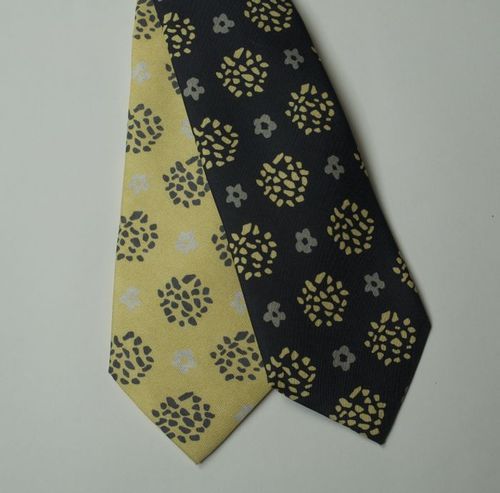
Indeed, one of the most recent houses to fall was Arnys, a Parisian boutique that was as famous for its designs as it was for its quality. In a world where the only ties that seem to be made anymore are striped reps and Macclesfield foulards, Arnys was one of the few places where you could get something original. Granted, I like striped ties and conservative foulards, but they can get a bit monotonous (plus, do we really need fifty makers for such things?). Arnys’ ties, on the other hand, were elegant, bohemian, and even a bit counterculture. Rive gauche style, in a way.

There are two silver linings, however. First, Morigi Milano has some old Arnys ties and they’re available for purchase online. The designs are a lot more wearable than the stuff you see recycled on eBay, and a number look like they’d go excellently with a cotton or linen suit. 

Second, as my friend Réginald-Jérôme informs me, Arnys’ tie designer Dominique Lelys is now doing his own thing under his label Le Lys. Sadly, while the ties are more unique than what you’d find elsewhere, they don’t have the same whimsical patterns of Arnys. The front blades are basic – simple stripes, dots, or solid colors – while the back blades are made with a contrasting piece of silk. The ties are unlined and made with a five-fold construction, and you can find them for $175 a piece at Cuffs.

Keep reading
Everything Old is New Again

image


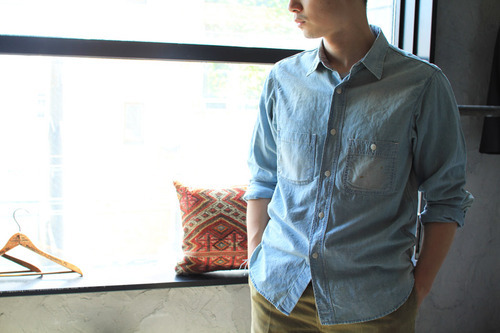
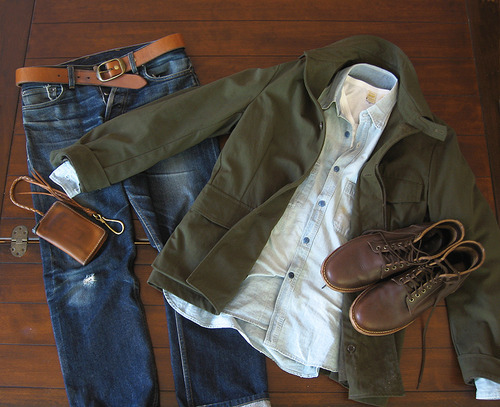
As it goes with fashion, everything old is new again. This time literally and figuratively, as I’ve come around to being less apprehensive about pre-distressed clothes. Pre-washed denim, for example, has a nice sky blue that’s difficult to achieve with raw denim, and the lighter color goes excellently with canvas sneakers in the summertime. I’ve also recently been wearing this heavily washed chambray shirt from Chimala. The problem with most chambrays is that they’re too much of a mid-blue, like this, which makes wearing them with jeans difficult. This chambray, on the other hand, goes great with jeans and a field jacket when the weather gets cold, and can be worn alone with a t-shirt and denim when the temperatures near 90, like they did yesterday.

Strangely, heavily washed chambray shirts don’t seem to be easy to find. There’s this Chimala (which is available at J. Crew and Unionmade), an RRL, and a slightly dressier version by Acne. If you’re willing to go a bit darker, however, a world of options opens up. Barney’s has an especially large range this season. There’s also this heavily washed denim shirt from The Jean Shop. It’s too thick to wear as anything but a shirt jacket, but it works well as one if you size down.

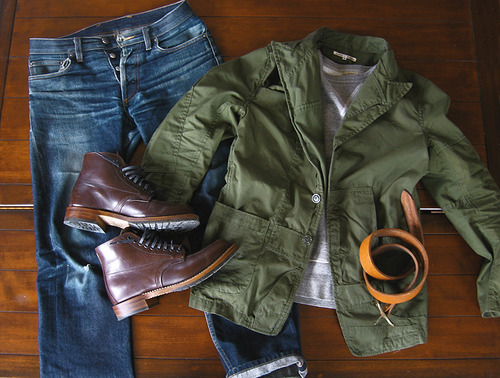
In the above, the boots are from Oak Street Bootmaker, the t-shirt from Barns, the jeans from 3sixteen, the wallet from Flat Head, the belt from Don’t Mourn Organize, and the field coat from Aspesi. The field coat is about five years old now, and is no longer available in Aspesi’s collections, but they make similar ones every season. APC also has a really nice field jacket with a detachable lining, and if money were no object, I like these by VisvimThe Real McCoys, and Ten C. For a budget friendly option, there's J. Crew’s Garrison

 is a great value. It’s a touch overpriced at full retail, but there’s rarely a week when J. Crew’s mainline isn’t put on sale in some way.  

Keep reading

Coming Back to Alden

image


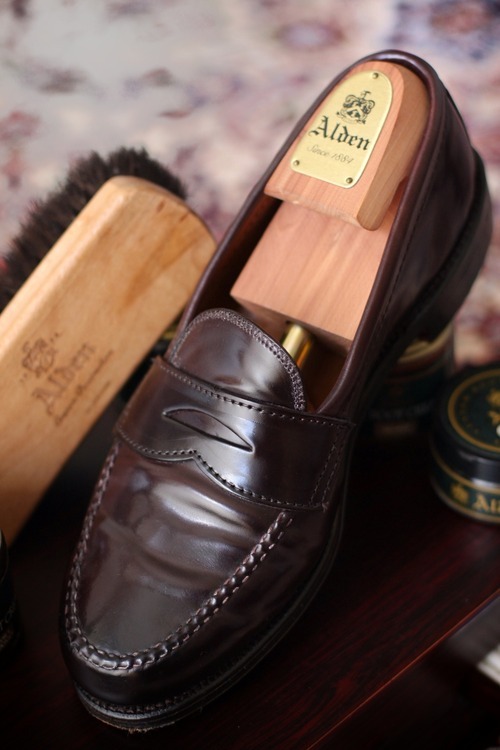
What happened to the Internet’s obsession with Alden? It was just a few years ago when you couldn’t get through a day’s worth of blog reading without coming across a post gushing about the New England shoe brand. Today, you rarely see the company’s name mentioned, and most people seem to have moved on to other things (obscure Japanese shoemakers and rare sneakers, mostly).

Meanwhile, I’ve been finding myself coming back to Alden. True, their lasts aren’t the sleekest and the shoes can look a bit clunky, but sometimes a heftier looking shoe is what’s needed to go with a pair of jeans or some tweed trousers. Plus, they have a distinct American sensibility that really appeals. 

In their permanent collection, some of my favorites include:

  • The Leisure Handsewn: Possibly one of the best penny loafers on the market, Alden’s Leisure Handsewn (colloquially referred to as the LHS) is handsewn right on the last. My favorite versions are the shell cordovan makes, which include Horween’s color 8 (known as the 986), cigar shell (6717), black (987), and Ravello (67540). The color 8 and black models are offered in unlined constructions through Brooks Brothers. The upside to that version is that, once in a blue moon, Brooks Brothers will include it in their 25% off mid-season sales. 
  • Flex welt shoes: Alden has a number of shoes built on their special flex welt outsoles, which is a thin, heavily oiled piece of leather that’s both water resistant and more comfortable out-the-box. I particularly like the chukkas in dark brown suede (known as the 1492), snuff suede (1493), and tan suede (1494). There’s also an unlined penny loafer in dark brown suede (6245F), snuff suede (6243F), and tan suede (6244F). Truthfully, I like the moc-toe style of Rancourt more in this case, but those won’t come with these slipper-like outsoles.
  • Wingtips: Still one of the best gunboat-shaped lace-ups, Alden’s longwings go excellently with everything from classic flannel trousers to slim-fitting jeans. You can find these in the more rounded toe Barrie last or the more shapely Plaza. Materials include everything from calfskin (black, new dark tan, dark brown, and natural Chromexcel) to shell cordovan (color 8, cigar shell, and black). If you stop by some stores, they may also have a few discontinued materials on sale. Just ask for them specifically, as they’re typically not displayed on the shop’s floor.
  • Boots: The Indy boot is Alden’s bestseller, but they can also be a bit ubiquitous (particularly if you frequent “hip” spots). For something more unique, I like their simple cap toe boots, such as the 4060 model (a color 8 shell cordovan built on their Grant last) and 39702 (a snuff suede boot built on the rounder Barrie). There are also some really nice Modified-lasted boots in this StyleForum thread.  

Finally, there are the hundreds of special makes Alden produces for stores around the world. Leffot, LeatherSoul, The Bureau Belfast, Need Supply, Winn PerryLakota House, and Unionmade are all good places to start.

Keep reading

New Inis Meain Sweaters

image


It feels strange to write about fall and winter knitwear in the middle of spring, but with some new Inis Meain models up on their webstore, it’s hard to not get excited. All of my sweaters from them have been exceptional. They’re remarkably soft, but hardly pill, and are so densely knitted that you never have to worry about them losing their shape. My oldest Inis Meain sweater is probably about six years old now. That’s not a terribly long time for a good garment, but with proper care, it looks just as good as the day I bought it.

Included in the new batch are some flecked “Donegal” sweaters that are made to resemble Irish tweeds. These were available for a brief season a few years ago, but were then replaced with a set of really expensive cashmere sweaters. The merino-cashmere blends are priced much more affordably, thankfully, and presumably have the thickness that such a design requires anyway. There are also some buttoned mock-neck Arans with handsome cabling designs, as well as a moss stitch Gansey sweater with a buttoned shoulder. I imagine the second might be useful for layering underneath a boring coat.

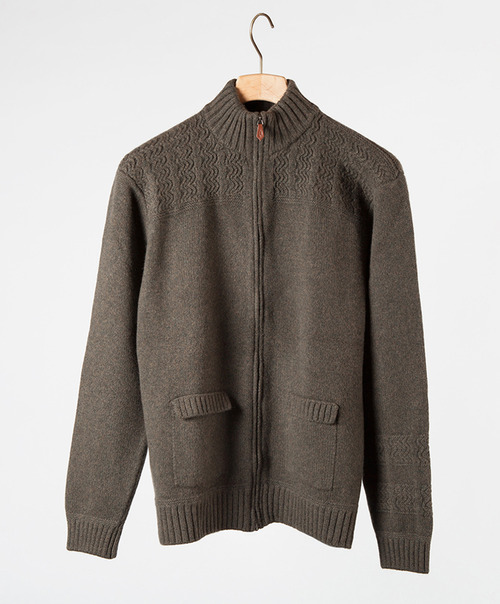
Perhaps most interesting is the mock neck cardigan you see above. I recently tried the navy zip cardigan that’s on sale at East Dane, but was disappointed to find that, when compared their buttoned cardigans, the tension in the zipper pulls the collar too far back.

No Man Walks Alone is apparently working on a new cardigan design with Inis Meain, and I’m told it will be made available later this year. Here’s to hoping it’s something like this model, but with a button closure.  

Keep reading

The Oddest Jacket

image


Inspired by a post I saw at Breathnaigh, I recently bought a Needles Rebuild jacket. It’s easily the oddest piece of clothing I own, and I say that as a guy who walks around town in a motorcycle jacket. For those unfamiliar, Needles is one of the brands under Nepenthes – a Japanese company that operates as both a retailer and parent company to a number of labels. In addition to Needles, they have Engineered Garments, South2 West8, and Sonic Labs. The company’s founder and director, Keizo Shimizu, designs Needles and Sonic Labs.

The Needles line feels very eccentric and bohemian. It includes this “Rebuild” collection, where individual pieces of clothing (often vintage) are deconstructed and used to “rebuild” new garments. Given the construction and designs, each piece is totally unique, even if the sensibilities across models and makes are the same. Take this BDU field jacket, for example. There are snap button pockets (presumably from the cargo pockets of BDU pants) on the interior side of the left lapel. One is so strangely placed that it’s in the middle of where the lapel folds over, which causes the lapel to sit strangely. Snap button pockets have also been used to reinforce the elbows, and there’s one pocket – upside down, even – placed right next to the patch hip pocket. Should you unbutton it, a ribbon previously used to cinch the waist on a pair of pants will unravel and fall out, reminding you that you’re in the Willy Wonka world of field jacket designs. 

I’m told by Pete (of Breathnaigh) that these pieces never really go on sale, and that their prices just keep on rising. It might be a moot point since, as I mentioned, every piece is unique. When I contacted The Bureau Belfast about their stock, they showed me the photos of the three mediums in this jacket they had left, and none really looked the same. I decided to just buy the one I liked most.

The Needles Rebuild collection has other pieces like this. There’s this flannel shirt, for example, which has been constructed from frayed, mismatched strips of shirting. There are also a couple of Led Zeppelin t-shirts made in the same way. Neither are things I think I can pull off well, but they do look cool. This BDU jacket though? I’ve been wearing it with 3sixteen jeans, a Buzz Rickson sweatshirt, and some Red Wing 9030 workboots. For the most part, it just looks like a rumpled field jacket until you look closer. It’s only then that you notice this is an odd jacket.

Keep reading

An Old Umbrella

image


My friend Réginald-Jérôme de Mans - who’s a weekly contributor to A Suitable Wardrobe’s blog - is remarkably good at finding menswear-related items on eBay. Or anywhere on the web, really. In fact, he was a guest on A Suitable Wardrobe’s first podcast episode for just this skill. It aired almost a full three years ago, but is still available for listening here under the title “Browsing for Bargains on the Web.”

What makes RJ’s finds exciting is that they’re often things of exceptional quality, such as leather goods from Hermes; stuff from the heydays of “once were” companies such as Old England and Arnys; or items slightly off the beaten path, such as intricately designed ties and the occasional … riding whip. When I can, I try to include some of his links in our eBay roundups over at Put This On. Except for the few times when I want something for myself.

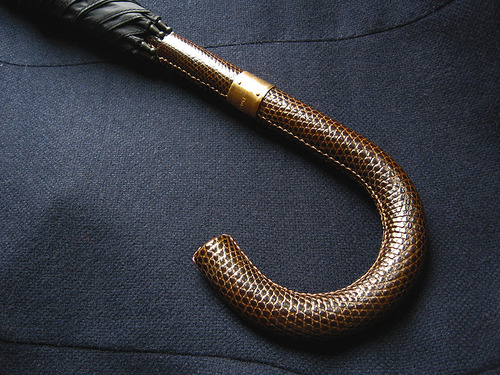
Like this old umbrella from Ralph Lauren I recently won. The handle is covered in a hand stitched, lizard skin leather; the shaft is made from a handsome, dark wood; and the frame is composed of eight strong metal ribs. It was supposedly made for the RL brand by the British Royal Warrant holders Swaine Adeney Brigg, which I admit I was originally a bit unsure of. However, there are a number of good signs: the nailed brass collar, metal tipped shaft, small mother-of-pearl button, and seemingly original, slightly yellowed, old tag hand sewn into the rib that indeed says “Brigg’ 100% Nylon Made in England.” There’s even two accompany tags - one with the Brigg label stating that the leather is lizard skin, and a small pamphlet instructing the owner on how to properly care for the umbrella. From what I can tell, this is a genuine article.

Unique makes of high-quality umbrellas tend to come in one of two forms. There are single stick constructions, where a single piece of wood is carefully bent with steam and pressure so that it forms both the handle and shaft. Then there are umbrellas such as this one, where the handle is either wholly made from, or just decorated with, a unique material. This can be metal, animal horn, exotic leathers, whangee, or anything that might set the umbrella apart from others. You can find both these types direct from their makers, or from online shops such as Oi Polloi (who has umbrellas with Malacca or leather-covered handles); A Suitable Wardrobe, Grunwald, or Mr. Porter (who have a variety of styles from Maglia Francesco, the largest Italian producer of high-quality umbrellas); Exquisite Trimmings or No Man Walks Alone (who carry my favorite maker, Mario Talarico); and online haberdasheries such as Kent Wang or Howard Yount (who offer their own private label line). The Armoury might also be a good source for Fox umbrellas now that they have a New York City store (readers in East Asia, of course, can just order from The Armoury’s Hong Kong location).

Keep reading

A Cruel Cosmic Law

image


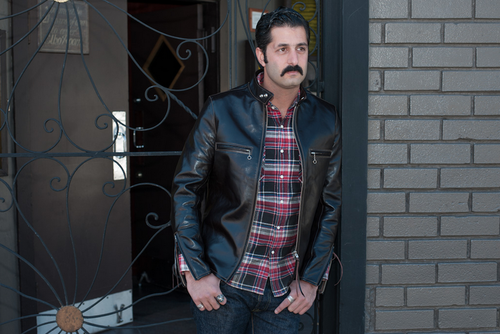
There must be some cruel cosmic law that puts everything we covet just outside of our reach. It doesn’t matter what your budget is. If you’re used to spending $200 on something, the thing you’ll want most will cost $300. If you’re used to spending $1,000, the most desirable item will cost $1,500. I was reminded of this when I stopped by Self Edge recently to try on some new jeans. While aimlessly browsing around, I also found a couple of great leather jackets, the star of which is this black cafe racer by The Himel Brothers.

Cafe racers are simple, single rider jackets with stand up collars, two to four slash pockets, and zippered sleeves. Although they were originally designed for just motorcycle use, they eventually came to symbolize American ideals of freedom and rebellion. Naturally, with social appeal came fashionable imitations, which is perhaps why Bruce Boyer once said that black leather jackets are just shadows of their former selves, “diluted to the point of mere role-playing.” That’s undoubtedly true, although I admit that doesn’t stop me from still liking them.

The Himel Brother’s cafe racer is made from a unique front quarters horsehide sourced from the Shinki tannery - the same Japanese tannery that supplies the great John Chapman. It’s a thin leather - much thinner than the horse or cowhides you’d typically find on the market - and consequently also much lighterweight. The semi-analine, vegetable tanned skin has been finished with a thin layer of wax coating, which presumably will give the leather a really nice “vintage” look once the jacket has been broken in. Other details include leather strips hung from the zipper pulls and a tiger camo lining in the interior. I’d normally find camo lining to be a bit cheesy, but I rather like it here. When worn, it gives the jacket a nice bit of rugged detailing. 

Unfortunately, it costs $1,950, and when I saw the price tag, I did one of these. Even more sadly, Self Edge never holds big sales. They have two a year, usually at a discount rate that matches the year’s number. So in 2012, they had a sale for 12% off; in 2013, it was 13% off; and this year, it’ll probably be 14% off. At that rate, I can probably afford this jacket in 2050, assuming it and I are still around. On the upside, The Himel Brothers has this same model, in limited sizes, at a slightly lower price on their website (they typically do custom orders). However, those will be made from different materials (presumably heavier and more traditional, which may be a good or bad thing, depending on your taste) and won’t have the same details.

Keep reading

A Post That Will Please No One

image


This post is sure to please no one. Not traditionalists who have no interest in anything outside of a coat and tie. Not workwear purists who dislike any kind of pre-distressing. And certainly not anyone who knows the name of this blog, who will rightly wonder why they’re reading about workwear on a site called Die, Workwear! But, so it goes …

Lately, I’ve been really impressed with Chimala. It’s a Japanese line that started in 2006, originally with a focus on women’s collections, but has recently expanded into menswear. Pants tend to fit a bit loose and full, and have a casual, carefree sensibility that I think is refreshing today’s skin tight fits. Coats and shirts are a bit slimmer, with the second being more so than the first. The line is slightly reminiscent of Japanese brands such as 45rpm, and will probably appeal to the same fan base.

Unfortunately, the nicest aspects of Chimala’s line – the subtle detailing and fabrication – don’t come through well in photos. Like the new Barbour Beacon collection, which is now designed by Norton & Sons’ Patrick Grant, these are clothes you have to handle in person to appreciate. This last season, for example, they made a navy shirt jacket from a really interesting wool/ nylon material. The fabric had a nice spongy feel to it, and seemed well suited for transitional weather. There were two side-entry pockets at the front with reinforced stitching, elbow patches at the sleeves for detailing, six corozo buttons for front closure, and a drawstring hem which, from what I could tell, was mostly for decoration. I really wanted to purchase it for wear with casual chinos, but figured nobody would pay the full retail price of $400. “I’ll smartly wait until it goes on sale, and get it at 40% off,” I thought. A week or two after first seeing it, my size sold out, and most of the remaining sizes went quickly after that.

There was also a really nice chambray shirt with many “standard” vintage details - vintage style buttons, triple needle construction, and run off chain stitching at the hem. Two pockets decorated the chest, with non-wonky cuts for people who are a bit tired of the strange designs that adorn shirts these days. The only controversial thing is the finishing. The shirt had been heavily washed and pre-distressed, and there was “faux darning” at the collar and one of the cuffs, which you can sort of make out in this photo. Light brown staining had also been applied to one of the chest pockets.  You can see similar details in their women’s line, such as this chambray shirt reviewed by Archival Clothing.

Keep reading

Chapman’s Traditional English Bags

image


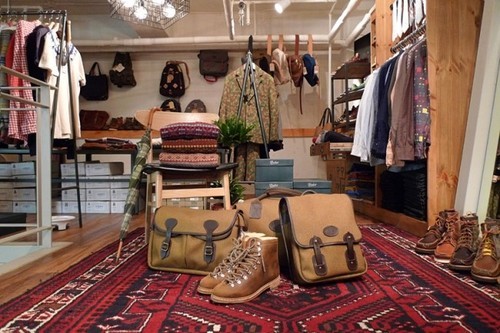
I’ve been wanting another game bag - the kind built from a sturdy canvas cloth and trimmed with vegetable-tanned leather. These are, to be sure, built for sportsmen, but I find they’re also perfect for lugging things around a city. A pocket intended for tackle can be used to hold a laptop charger, and any large compartment meant for game can be used to store laptops, books, and some papers. Used with a Barbour jacket and some boots, I can’t think of anything better.

I bought a tan fishing bag last year from Ralph Lauren, and was hoping to get the green one this season for variety. It sadly didn’t make it to their sale, so I’ve been looking to more traditional English makers. At the top of the list is Chapman, a company named after and started by John Chapman in the early 80s, right after Barbour acquired the bag maker Liddesdale (where John Chapman had been working). It was a risky, but ultimately smart move, as Barbour would eventually shut down Liddesdale and move its bag production overseas. By that time, however, Chapman was already a thriving business selling British made bags all over the world, winning over the hearts of outdoorsmen, and even producing for brands such as Holland & Holland and Purdey.

Chapman is now owned by Daniel Chamier, a former banker who took over the company in 2006. The operations remain the same, however. There are just sixteen full-time employees, who do everything from hand-cutting the original patterns to finishing all the traditional saddlery work. In addition, not only are the bags produced in the UK (in Carlisle, just four miles from my tailor, coincidentally), but they also use UK materials. Tweeds are from Scotland, wools from Yorkshire, and leathers from a tannery in Kent. These are fully English, inside and out. 

I’m told that while fishing and shooting bags still make up a big part of the company’s business, most of their bags are used for non-sport purposes. In fact, it seems that they’re looking to expand that range. This past year was the company’s first showing at Pitti Uomo, and they’re continuing to build collaborations with fashion brands and stores around the world. For example, some of their best products (to my eye anyway), are done with the stylistic direction of companies such as London Undercover and No Man Walks Alone, who take standard models and spec them with their own choices in materials and colors.

Keep reading

Gyakusou: The Other Sportswear

image


There’s much written about the kind of sportswear associated with sports few men play (polo, quail hunting, boating, etc), but little about the clothes we need for the kind of sports most of us engage in. Recently, however, it seems that everyone has picked up the new Gyakusou collection - that special collaboration project, now in its third year, between sportswear giant Nike and Japanese designer Jun Takahashi. Takahashi is famous for his cult fashion label Undercover, but he’s also an avid runner, regularly covering 10-15k distances in his hometown of Tokyo. The name of the collaboration is actually taken from his running group, the Gyakusou International Running Association. “Gyaku” means reverse or wrong way, and “sou” means run or running. Together, the word gyakusou is a reference to the group’s practice of running counter-clockwise around the parks of Tokyo, rather than the standard clockwise direction.

The line is essentially high-end fashion athletic apparel aimed at runners, and this season’s collection differs from those of the past in that it’s a bit more functional and simplistic in form. Gone are the extras zippers and pockets that have been previously used to distinguish the line as “designer,” and instead of color blocking, we see simple tonal colorways. What stays, however, are functional details. The collection’s best jacket, for example, has a small, unique chest pocket, just big enough for a set of keys so that they don’t jingle when you run. There’s also a zippered back that reveals some highly breathable mesh, so you can get more ventilation if necessary. In addition, the line continues to use Nike’s innovative technologies. The fabrics are lightweight and designed to wick sweat away from the skin, and certain panels are made with stretchier fabrics in order to allow greater ease of movement.

There’s a part of me that recognizes how ridiculous all this is. I wouldn’t consider myself a runner, but I do run about three or four miles a day, I appreciate the sport for its simplicity. All one needs is a pair of proper running shoes. The over-design of these clothes, on the other hand, remind me of Grant Petersen’s book Just Ride, which encourages bicyclists to get away from the ultra lightweight gear, flashy jerseys, and clunky shoes, and return to the simple joy of riding. Most people are not training for the Tour de France, after all, just as I imagine most people buying Gyakusou are not doing serious marathons. 

At the same time, it’s difficult to find attractive running clothes, and to the extent we use clothing to look and feel good, is it so bad to like this line? After trying on a few pieces, I already want one of the jackets, and although the shoes are not practical for a pronator like me, I wouldn’t mind using a pair for short ~2 mile runs.

Keep reading