Esk Cashmere

image


For those who can’t get enough knitwear, Esk Cashmere is worth keeping an eye on. The brand is a new ready-to-wear label by the knitwear factory Esk Valley Knitwear, which is located in the southwest of Scotland. Having started in the 1960s, the family-owned business has been making knitwear for a number of high-end British brands for years. Now, they’ve gone into the ready-to-wear business for themselves.

Esk Cashmere’s line is split into two parts. There’s the more contemporary seasonal collection and a permanent classical line. The latter is fairly straightforward – lots of basic crewnecks, v-necks, cardigans, and sweater vests made to the highest standards possible. Many are constructed from four-ply cashmere yarns or higher and seamlessly knitted on Shima Seiki machines. Being fully fashioned, the panels are knitted to shape (like a sock) rather than cut from larger pieces of cloth and then sewn together (like you would do for a shirt). The pieces are then skillfully assembled by hand-linking each stitch, point-by-point. This not only results in a smoother finish, but it’s also a slower, more labor intensive process that’s typically reserved for higher-end garments.

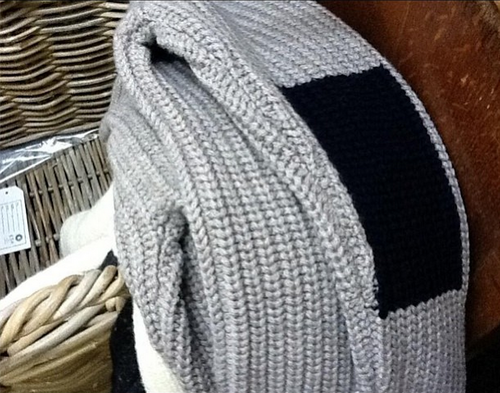
The contemporary collection is made to the same standards, but the designs are dramatically different. Ex-Joseph designer Lorraine Acornley works to make the sweaters look modern and distinctive, but also subtle. This fisherman knit, for example, has contrasting, intarsia, color block patches at the forearms, while this 10-ply cashmere sweater is made with a chunky collar and button detail. For something more discrete, check out these Shetland crewnecks. They’ve been knitted to be double-faced, so that a soft lambswool faces the inside, while the more traditional Shetland wool faces out.

Keep reading
Casual Textures

image


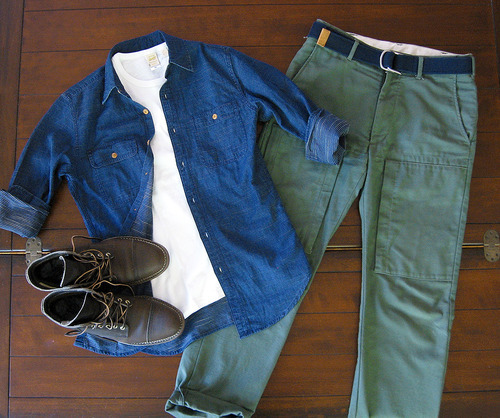
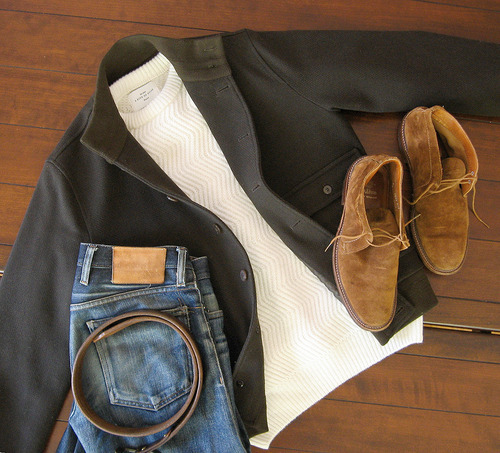
Textures are often a lot more interesting in casualwear than they are in traditional, tailored clothing. Pictured above is a cream colored knit is from the relatively new label A Kind of Guise. It has a groovy pattern – both figuratively and literally – that I think has a nice sense of playfulness. The dark green A-1 blouson is from Valstar (which at the moment is on deep discount at Yoox). It’s constructed from a rough, basketweave wool that has a much more visible texture than the pictures let on. Next, the straight-legged jeans are from 3sixteen. They’ve been worn-in enough that the streaky grain on the denim has started to show. Finally, the suede Alden chukkas are unlined, giving them a floppy and more relaxed character. 

You can get good, textured casualwear at any number of places. Carson Street Clothiers has a navy Eidos bomber made from Casentino wool (which, along with all outerwear and tailoring, is on sale today at 30% off with the checkout code OW30). Much like the teased out fibers on a brushed Shetland sweater, Casentino wool is beaten until it achieves a charming, pilled look. For knitwear, No Man Walks Alone has some modern looking pieces from Stephen Schneider, while S.N.S. Herning offers some really great designs rooted in traditional Nordic clothing (I really want this dark striped sweater). Even with more traditional fabrics and designs, when they’re paired in unexpected ways, you can achieve a much more unique looking garment. 

As usual, if you don’t want to wear a bunch of crazy patterns or colors, you can always try textures. Casualwear often has the more interesting ones. 

Keep reading

Possibly the Best Sport Coat I’ll Ever Own

image


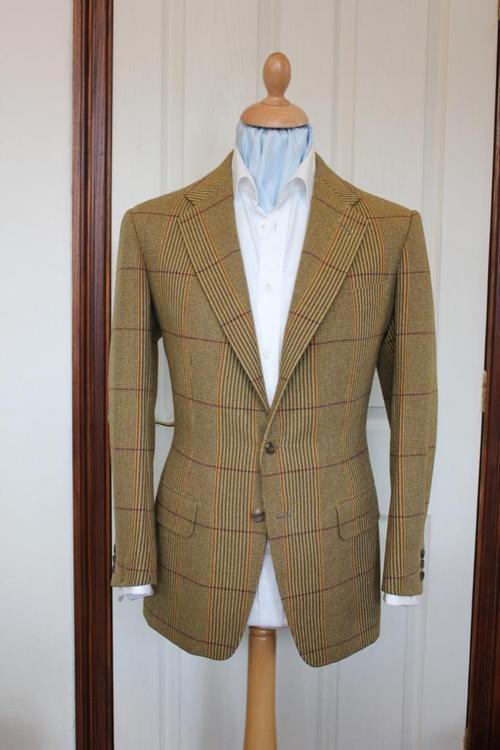
I may be speaking too soon – as this jacket is still in transit to me – but this Russell plaid sport coat by Steed may be the best tailored jacket I will ever own. It was inspired by a photo of George Frazier, a writer who started his career as a jazz critic before moving on to more general topics. In 1960, Esquire published his essay titled “The Art of Wearing Clothes,” which in my opinion, is one of the best pieces of writing on men’s style that has ever been penned. A must read, if you haven’t already.

Russell plaid is a distinctive check. It’s something like a tan glen plaid, but with the horizontal stripes stripped away, so only the vertical ones remain. For the lateral sections, there are dark, thin lines, typically in plum, brown, or rust orange, which help balance the rest of the pattern. You can find it in the form of a made-to-order hacking jacket at Leonard Logsdail, or in Harrisons and Hardy Minnis’ books if you’re going bespoke. Mine is from Harrisons (Porter & Harding’s Hartwist No. 32137), which is a darker color than the beigey version you’ll find from Hardy.

This jacket reflects Steed’s house style well, although I did have some things adjusted. The quarters are cut slightly more open, to give the jacket a dynamic look, but aren’t so open that I feel they define its style. I also asked for flapped welted pockets, rather than my usual patch, as I felt they’d give the tweed a certain kind of refinement. Additionally, I had the details done up in a more American or Italian sensibility, rather than British. The front is made with a 3/2 roll and a cheeky three buttons on each sleeve, rather than Steed’s default of four.

Keep reading

The Story of How You Saved Money

image


For anyone who doesn’t want to pay bourgeoise money to look proletarian, J. Crew's Wallace & Barnes sub-line is worth checking out. The line has been around for a few years now, but has surprisingly attracted little attention from the menswear community. Not totally sure why. The pieces have more of a boutique feel than J. Crew’s mainline, are made from considerably better materials, and are supposedly inspired by the vintage pieces that Frank Muytjens and his team routinely collect for their design archive. All things that make other lines appealing, except that Wallace & Barnes doesn’t come with the same price tags. 

Take these two shirts, for example. The first is made from a heavy and thick cotton canvas, and has an interweaving of brown and cream yarns that gives it a unique textured look. The side seams, yoke, and sleeves are all tripled-stitched, and the overall construction has a sturdiness that’s more reminiscent of RRL than J. Crew. The second shirt is an inky-blue, deep indigo-dyed piece, with a white pin dot pattern that has been woven into the fabric (rather than printed on). The subtle variegation in its coloring makes it feel more hand dyed and special – something more like what you’d expect from a niche Japanese label. I picked up both shirts on sale for $35 and $65, respectively. You can hardly drink at a bar in San Francisco these days with that kind of money. 

Granted, the designs are not particularly unique, but the fabrications are nice, and the clothes are simple enough to be versatile. This season, Wallace & Barnes has things such as washed chambray shirts, which look better than Uniqlo’s (faux) Pure Blue Japan offering, and comes at a cheaper price than Chimala’s (you can add your own wear-and-tear for a more authentic look). There’s also some Japanese selvedge cotton chinos, which come in a heavier weight cotton than Left Field’s (a brand that I’ve come to really like), and a grey sweatshirt that’s presumably better than the company’s mainline. All things that you can probably pair with whatever casualwear you might have in your closet. 

Keep reading

City Squares

image


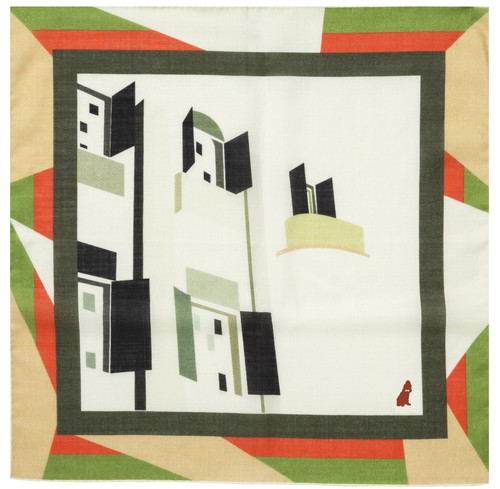
For those who want to take the term “international style” a bit literally, Australia-based designer Christian Kimber has been slowly building a collection of city-themed pocket squares that I think is both highly unique and appealing. The squares all feature original art by the designer, and are inspired by the different cities he’s been to. The London square, for example, features the Gherkin skyscraper that he used to pass by every day, while the Hong Kong square is inspired by the skyline he saw in Kowloon (where my shirtmaker Ascot Chang is based, coincidentally). I’ve been admiring the set for a while, but had to wait until the Kimber released his square for Vietnam – where my family is originally from – before I bought my first one.

The designs are great, and have a nice international flavor that I think most men can appreciate, but it’s the abstracted shapes that make them a bit more unique than my usual favorites from Drake’s, Rubinacci, and Holland & Holland. In the pocket, they take on a modern look, perhaps more in the line of Tom Ford than any of the aforementioned companies. Twist a little here or there, and you can show off different colors as you wish. The size, thankfully, is also big enough to not slip down the pocket (something that’s increasingly hard to find nowadays, unfortunately). Quality and make here are similar to Drake’s, and I believe both lines are produced at the same factory. 

I’m told that more designs are coming. There will be one for Milan, Italy and one for Colombo, Sri Lanka. Those might not be out for a while, however. Kimber is a one-man operation and currently working on expanding his footwear line with some new sneakers from Italy and more Goodyear-welted shoes from Spain (suggesting, perhaps, that a Spanish square might be forthcoming). In the meantime, you can find five designs at Kimber’s website and Exquisite Trimmings, the second of which is having a 20% off sale with the checkout code BANK20. Unfortunately, the code doesn’t apply to these squares. I know cause I checked. If it did, I would have bought a few more.

(Photos from Christian Kimber’s website and Instagram, as well as me) 

Keep reading

Vintage Russell Moccasin Catalogs

image


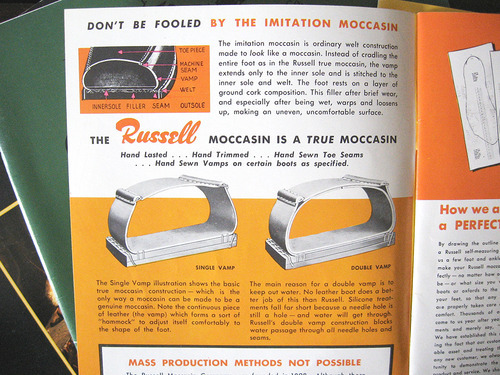
Before custom shoemaking in the US was mostly bespoke and made-to-orders, there was a small niche of manufacturers who would make shoes based off of the individualized foot tracings that customers would mail in. Russell Moccasin was one such firm. They sold shoes through outfitters such as Orvis, Eddie Bauer, and Abercrombie & Fitch (when the company still served outdoorsmen and adventurers), as well directly to customers through their large catalog business. 

Here are some photos of such catalogs. These date back to the early ‘80s and late '90s. Notice that every one includes a foldout form, which has a Brannock-looking diagram on which you’re supposed to trace your foot. This tracing – along with fourteen other measurements you’re supposed to provide of your feet and legs – is what gave Russell enough information to make you a perfectly fitting pair of sport shoes.

Russell still makes custom shoes from self-tracings today. I think they might be the only firm to do so, although there are probably a few Northeastern manufacturers that I’m missing (LL Bean, from what I remember, used to offer this service, but it’s all ready-to-wear now). If you’re interested in ordering a pair, you can browse this Japanese site for design ideas. Ready-to-wear models are available at HavenContextNepenthes, and Sid Mashburn, and you can find discounted shoes at Russell’s sale page and eBay account. The second will have shoes going for particularly low prices, so it’s good to check back regularly if you already know your sizing.

Keep reading

Vintage Allen Edmonds

image


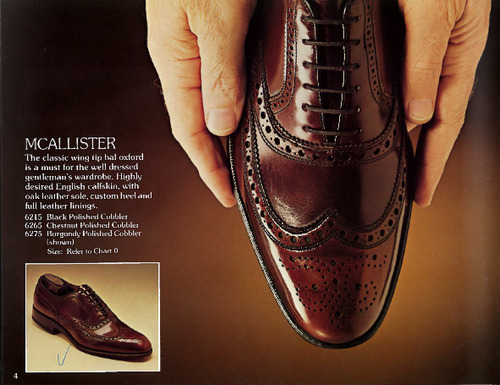
Step into any vintage shop today and you’ll find the surviving traces of a once-great American footwear-manufacturing sector. To sure, good shoes are still being produced in the US, but the industry isn’t what it used to be. Its last heave was in the 1940s and ‘50s, when companies were bolstered one last time by a boom in sales – first from the US government, who needed to supply troops abroad with quality shoes, and then from the growing domestic workforce in the immediate postwar period.

Since the ‘60s, however, things have gone into steep decline. The introduction of affordable synthetics and increased competition from abroad have forced many companies into producing cheap crap. Just compare anything made nowadays by firms such as Stacy Adams and Bass, to what they produced seventy-five years ago, and your mind will be blown.

Today, there are only a few companies that still produce in the US, unless you count the small number of handsewn moccasin manufacturers and few bespoke makers of cowboy boots. Of the big companies, most have off-shored much of their production, even if they’ve kept some of it here. Heck, even some shoes stamped “Made in the USA” aren’t necessarily made here at all. When Allen Edmonds was sold in 2006, for example, and ownership passed from John Stollenwerk to the Minnesota-based equity firm Goldner Hawn Johnson & Morrison, the company shut down their Lewiston, Maine factory and opened a new one in the Dominican Republic. There, some shoes are half produced and then sent back to the company’s main plant in Port Washington, Wisconsin, where they’re “finished” and stamped with a “Made in the USA” label, while others are fully produced in the Dominican Republic and correctly labeled as such.

Keep reading

Six New(ish) Brands I’ve Been Watching

image


Yves Saint Laurent was once quoted as saying, “I am no longer concerned with sensation and innovation, but with the perfection of my style.” I wish I had that kind of singular focus. While I’m mostly interested in tailored clothing, my eye wanders when it comes to casualwear. I find myself sampling here and there, being drawn to new brands and styles every so often. Here are six newish companies I’ve been looking at this past year. Perhaps you’ll find something to like as well. 

image

image

image

Keep reading

The Magic of Steam Stations

image


Most menswear reviews go something like this: a ridiculously trivial problem is blown out of proportion, and some expensive item is proposed as the solution. The slightly uncomfortable experience of being caught in a drizzle, for example, can be solved with a handmade raincoat with bonded seams; the slightly-off fit of ready-to-wear shoes can be solved with something bespoke; and any difficulty in understanding Four Pins can be solved with someone young and hip, serving as a personal translator. 

In reality, most things have a steep diminishing returns curve, and much of what you need can be satisfied for not too much money. For ironing, I recommend Black & Decker’s D2030 iron, any kind of non-countertop ironing board, and a basic spray bottle (since most irons are terrible at spraying mist or steam). All three can be had for less than $100. 

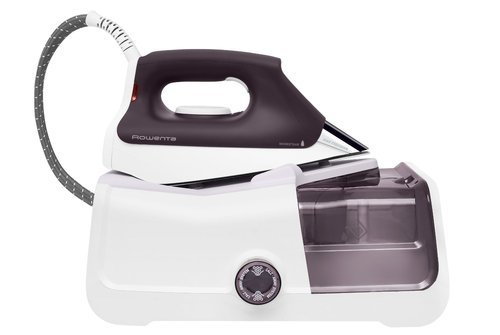
In the last year, however, I’ve fallen in love with steam stations, which are irons that give continuous and powerful blasts of steam. Although they’re not as effective as the infomercial above would like you to believe, they’re surprisingly not that far off. With one in my hand, I feel like a disgusted prince, sending servants away with a few flicks of the wrist. “Begone, wrinkles!”

The problem with steam this powerful, of course, is that you risk puckering seams, delaminating fusing, and taking the shaping out of tailored clothes. Jeffery Diduch has done a lot in educating people on StyleForum (including me) about this subject, and you can see the ill-effects a steamer can have on a garment below. 

Keep reading

“Must Traitors Sleep in the Buff?”

image


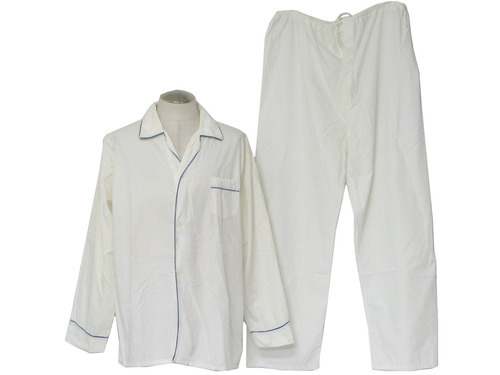
At the end of An Englishman Abroad – a 1980s BBC television drama about the real life events of Guy Burgess – Coral Browne is sent to do some West End shopping on Burgess’ behalf. Burgess, for those unfamiliar, was a British intelligence officer who was exiled to Moscow for having sold secrets to the Soviets during the Cold War. He says in the film that he’s not unhappy in Russia, but it’s clear that he acutely misses the everyday cordialities of an English gentleman’s life, and the things that go along with it. So, to help him along, Browne gets some things from his old clothiers – suits from Tautz, and shoes from John Lobb. She has no trouble until she goes to “Seka” (which is supposed to be Sulka) to order some pajamas. Burgess wants them to be white or off-white, or navy blue silk. “Only then,” he says, “will my outfit be complete.”

At Seka, Browne is denied, and the salesman says that the firm is only too happy to be rid of a national traitor as a client. She sharply replies, “must traitors sleep in the buff?" You can see the whole sequence at the 50 minute and 40 second mark of this YouTube video. It’s a fun watch, if only to check out some of the real life shops of Tautz/ Hogg, Sons & JB Johnstone, John Lobb, and Turnbull & Asser (the last of which is where the Seka scene was filmed).

Anyway, the movie came to mind this weekend as I put together an order with Ascot Chang. Fox Flannels is holding a sale on their A1285 cloth, which is a slightly dark shade of mid-grey flannel that I think would make for some great trousers. A generous 40% can be taken off the price with the code WOEcloth, and you can expect another 20% off if you’re exempt from VAT. That puts the price lower than what Minnis charges. 

I figured this sale would make for a good excuse to pick up some of Fox’s mid-grey windowpane flannel as well, which I’m planning to send to Ascot Chang to be turned into a dressing gown with white piping. It should look much this gown sold by The Merchant Fox as ready-to-wear, but will better fit my skinny frame. And while I’m at it, a couple of linen and linen/ cotton blend pajamas to go with, probably in white, off-white, and light blue. No poplins, as light-blue pajamas in plain weaves look vaguely clinical.

Keep reading