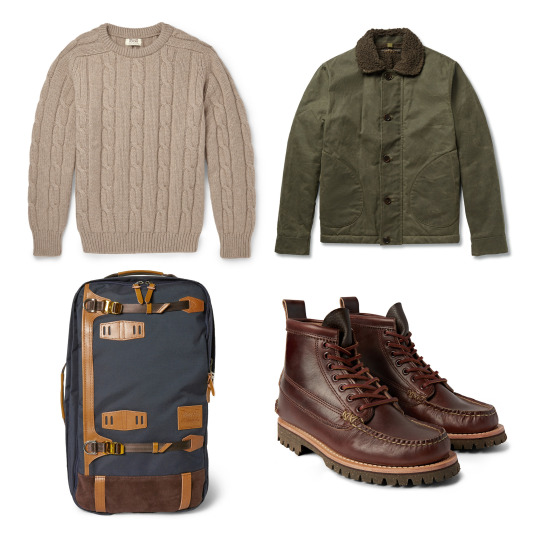
Mr. Porter just started their end-of-season sale, with discounts of up to 50% on select items. Lots of familiar labels, such as Drake’s, Common Projects, and Red Wing, as well as a number of not-often-discounted brands such as William Lockie and George Cleverley. Some notables that I found last night:
End is probably the only online retailer that rivals Mr. Porter in scope and quality. Today, they start their end-of-season sale. Take 25% off across the board with the checkout code SALEPREVIEW. Some notables:
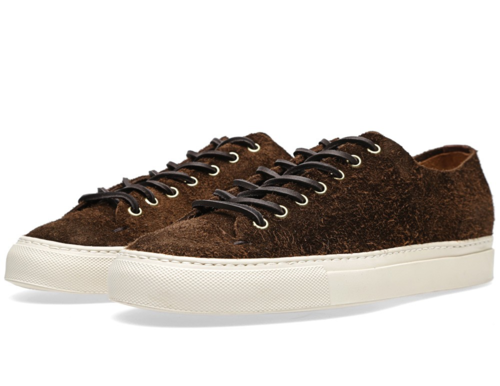
What happened to internet’s love for chunky shoes? It seems like it was only five years ago when people couldn’t get enough of Aldens, and now everything is about sleek, city designs from Europe. Granted, I like a tight-waisted, shapely shoe as much as the next person, but there’s something appealing about an unapologetic chunky design.
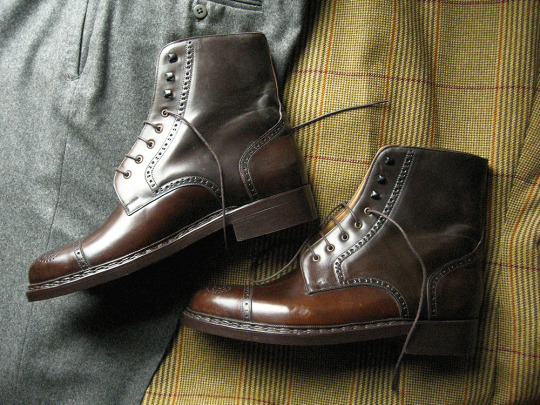
The best chunky shoes come out of Central and Eastern Europe. In the days of the Austro-Hungarian Empire, shoemakers along the banks of the Danube in Budapest and Vienna used to make footwear for country gentlemen and Army officers. For hard wear in tough conditions, they made shoes that could take a hit from a round-nosed bullet – and perhaps looked like one too.
That kind of shape doesn’t photograph as well as the kind of tight-waisted, sleek shoes that come out of Italy and Japan, but they look tremendous with the right clothes. Think: cavalry twills with ribbed corduroys, or warm flannels with heavy tweeds. These are basically country shoes you can wear with country clothes (or in more modern terms, the kind of stuff you want to wear in the fall).
End started their fall/ winter sale last night, with 40% taken almost across the board. There’s a ton of great casualwear from a number of brands. Here are some notables:
Barbour: Discounted Barbour (this time available to US customers). Nice, basic waxed cotton jackets starting at about $200.
Mackintosh: Rather than going for the poly-blends and cotton twills, I recommend ponying up for the bonded cottons (they’re the ones that retail for $1,000+). The upcharge is worth it.
Elka: Casual raincoats that are a little more affordable than Stutterheim.
You can also go through their sale section, which is organized by types of clothing (shirts, jackets, shoes, etc). Possibly easier if you’re shopping for something specific.
Just as we have comfort foods, we have comfort clothes – the soft feel of heavy flannel trousers; the familiarity of a button-down collar shirt; and the scratchiness of tweed that can make us feel protected. Last month, my friend David wrote an interesting history on Donegal tweed at No Man Walk’s Alone’s blog.
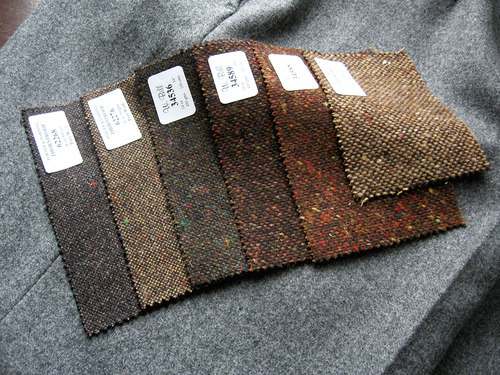
As David put it, Donegal tweed is the product of Irish self-efficacy and survivalism. Ireland has always been a major exporter of linen, but for most of its history, its wool production has lagged – thanks in part to British tariffs against foreign wool. As a result, the production of Donegal tweed maintained its labor-intensive methods well into the 20th century since there was no need for mass production. And when England established a trade board to help increase Irish linen production by distributing linen spinning wheels, the residents of Donegal – who lived in a climate too cold for growing flax – took those wheels and ingeniously made them spin wool.
Of course, tweed in Donegal is now woven on modern machines, but its production remains fairly small and artisanal (at least when compared to other mills). Molloy & Sons, for example, is just a two-man operation (literally a Molloy and his son) that weaves in a small building next to the family’s home. Most of what they produce nowadays is for fashion labels in the US, Western Europe, and Japan (this season's Eidos’ field jacket and topcoat was made from their cloth). My friend and colleague Jesse at Put This On made a great video about them here.
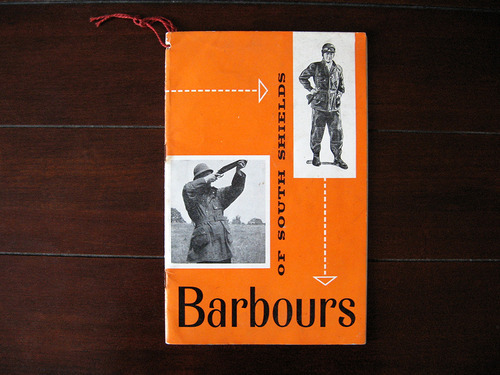
I love old clothing catalogs. For the kind of damp, cold weather we’ve been having, here’s a throwback Barbour catalog from the autumn of 1962 – printed back when the company still offered country suits and shoes. Those shoes used to be made by John White, a Northampton firm that has sadly gone into steep decline (I don’t believe they’re actually even made in the UK anymore). Those, of course, have been discontinued from Barbour’s line, but what remains is what Barbour has always been most known for: outerwear.
Here you’ll find Barbour’s Thornproof coats for hunting and fishing; iconic belted International jackets (which back then was sold as part of a suit), and rubberproof riding coats. I actually spent a bit of time last week searching for a riding coat online, after having read this post at A Suitable Wardrobe. One seller I found described it as “something great for historical re-enactment.” That admittedly gave me some pause, but probably won’t stop me from eventually buying one. I’ll wear it to costume parties.
Another favorite is the anorak you see in the second-to-last photo below. Made from a densely woven, light fawn Gabardine, this piece featured an attached hood, a single Kangaroo pocket, and two flapped hip pockets. Internal wind cuffs helped keep the chill out and a drawcord waist helped give the garment some shape. If it were made today, I’d mostly certainly buy one.
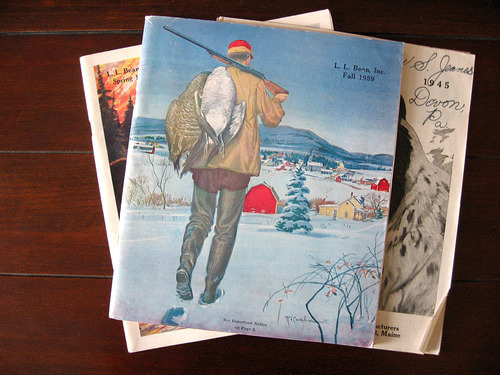
Old LL Bean catalogs can be really fun to flip through this time of year. To be sure, they print and mail out catalogs year-round, but it’s their rubber duck boots, handsewn moccasins, and heavy field coats that feel so representative of the company – and so quintessentially fall.
I’ve collected some of their catalogs throughout the years. Here’s one from 1959, which was printed just a short while after they first introduced their women’s wear collection. Like with most mail order catalogs (at those dealing with clothing), the women’s stuff is put at the front of the book, while menswear is placed at the back. Included in this one is also LL Bean’s outdoor gear spread throughout. I’ve skipped the women’s wear and outdoor supplies for the sake of brevity, but there are still plenty of menswear things to keep one amused. And impressively, fifty-five years later, also plenty of things I’d happily buy.
The whole Americana trend seems to have passed, as fewer and fewer menswear blogs talk about brands such as LL Bean. However, as the writer behind Heavy Tweed Jacket once wrote about this stuff (when he was still writing), they feel forever appealing because they have a sense of “genuineness” to them. Perhaps a little hokey, but also hard to deny.
Christian at Ivy Style once called me a clotheshorse. If you know Christian at all, you know that’s not a compliment. He’s one of the few bloggers I know (if not the only one) who has a healthy relationship with clothes. He likes them, but doesn’t obsess over them. In any case, what prompted it was me asking him last spring what he thought of some brand’s sweaters. He said “You’re one serious clotheshorse if you’re already thinking about fall!”
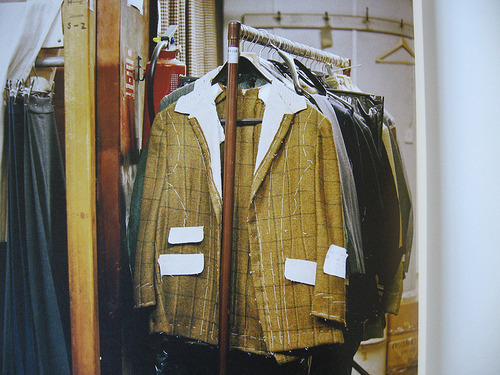
And it’s true, I tend to think about clothing purchases way in advance. Lately, for example, I’ve been thinking about green tweed sport coats. The London Lounge is selling a new barleycorn and herringbone mix through their cloth club. It’s a beautiful design with a blue and chestnut brown windowpane, but I’m not yet sure of what’s out there, so I’ve been unable to commit. Flipping through A Style is Born and Scottish Estate Tweeds gave me some ideas, however. As did going through some photos I’ve downloaded throughout the years. All are included below.
My intuition is that lighter, more olive-ish shades of green are easier to wear than anything too true. Lest one wants to look like they’ve recently won the Masters Tournament anyway. But the photo of Gianluca Migliarotti (director of O'Mastand I Colori Di Antonio) proves otherwise. I think it may be more about the cut than the color. With a well-cut, soft shouldered jacket, a green sport coat seems like it could go excellently with a pair of a khaki chinos, grey flannels, and tan cavalry twills. Something to also wear with a light blue or country tattersall shirt, and perhaps some brown suede wingtips.
So far, my two favorites include the photo of the Kylnadrochit estate tweed at the very end of this post, and the one seen on Michael Alden in his video on how to wear a pocket square. Those pitch perfect shades of olive, with the subtle and tasteful checks, look like they’d make for a great autumnal sport coat. Especially for a guy who thinks about such things in spring.
Drake’s released their fall/ winter 2013 collection yesterday. It hasn’t received that much fanfare on blogs yet (even in the ever-quick Tumblr-sphere), which is surprising given how many fantastic things there are.
Like last season, this collection seems to have a nice focus on textured neckwear. There are the traditional things, such as raw silks and tussahs in both solid and patterned designs, as well as plays on standards, such as variations on the traditional grenadine. In addition, there are some nice designs with a 1950s/ 1960s sensibility, such a fuzzy mohair blend and a range of boucles. The word boucle comes from the French word boucler, which means “to curl,” and it refers to how the yarns are formed. The fabric is made with a series of looped threads, typically with one being a bit looser than the others. This looser thread forms a small curled loop in the fabric, while the others form the anchors. The effect is a fabric that looks very textured and interesting, and feels slightly rough to the touch. I think of it as a fall/ winter version of raw silk and like to wear mine with tweeds.
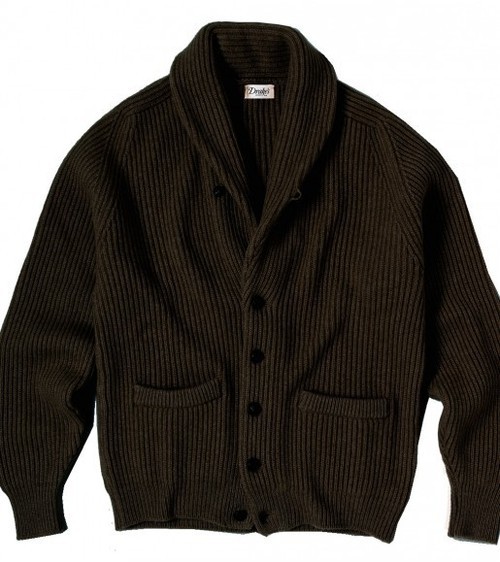
Alongside their neckwear is Drake’s usual mix of other men’s accessories, such as their beautiful, finely woven scarves, which this season comes in a range of tartan, Fair Isle, Navajo, and Kelim patterns. I also lusted over their knitwear. Some of their Guernsey and Aran sweaters looked very much like those sold by Inis Meain, which makes me wonder if that’s not who manufactured them. There are also some Shaggy Dogs, cabled lambswools, and Shetland knits in birdseye and Fair Isle patterns. Oh, and the four-ply cashmere shawl collar cardigan pictured above, which is not new, but so great that I’ll use any excuse to use the photo.
Two big highlights for me include their sport coats and pocket squares. I believe this is their first season offering tailored jackets online, and I suspect if it goes well, we’ll see an expansion of offerings in the future (previously, the only way to really buy their sport coats is to go to their London store). This season’s selection of pocket squares is also quite exciting. I think it may be their best yet since their medieval prints many years ago.
My shirtmaker Ascot Chang was at San Francisco’s Fairmont Hotel this week, and they confirmed for me something I’ve been suspecting for a long time. After a year of unhealthy eating and not enough exercise, my shirts seem to have shrunk about an inch in the waist. So my pattern will be adjusted for future orders, which makes me think: as exciting as it can be to try out new tailors when you’re abroad, if you plan to have the majority of your clothes custom made, it’s good to have someone you can dependably see on a regular basis. People’s bodies change, and although adjustments can sometimes be made over the internet with a little guesswork here and there, nothing beats having your tailor see you in person.
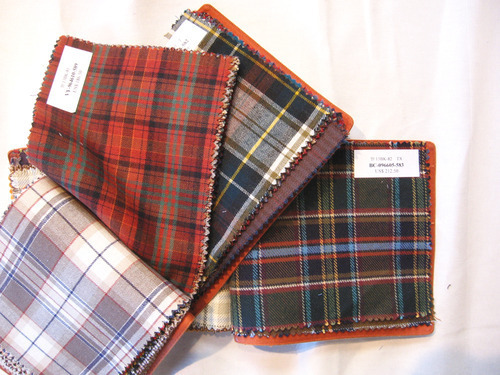
Anyway, while I was there, I decided to flip through some flannel shirtings. Pictured here are some brushed cottons and Viyella wool/ cotton blends. Viyella is an English fabric that was first woven in 1893, making it the first branded fabric in the world. I actually thought they had moved on to becoming a clothing and home furnishings company, and no longer made their famous blended shirtings, but it seems Ascot Chang had two books full. Maybe these are old stock? I forgot to ask.
I’m thinking about picking up one of the green/ cream/ gold plaids to wear with brown corduroys and moleskins in the fall, and though the cream tattersall - with grey, burgundy, green, and navy stripes - doesn’t look appealing at first, I think it can work quite well underneath a tweed or corduroy sport coat. Two flannel shirtings to start with, and then maybe a navy thin-waled corduroy shirt with two button-flapped chest pockets if I’m feeling brave.
Ascot Chang will be doing another tour sometime around November. You can see which cities they visit here. And since this year is their 60th anniversary, they’re doing a promotion where you can get one free shirt with any six you order. Expect prices for basic fabrics to start around $175.