Steven Hitchcock, Soft English Style

image


Tailoring is often described in regional or house terms. Anderson & Sheppard’s iconic drape cut is soft shouldered and full throughout the chest, making even the most frail and pudgy look athletic. Conversely, Huntsman’s imposing shoulder line and flared skirt, which kicks out from the hips, accentuates their X-shaped silhouettes. Huntsman’s cut is derived from their heritage, obvious from the company’s name, back when the firm used to tailor for Europe’s hunting and riding aristocracy.  

Over the years, I’ve realized these generalizations only take you so far. In reality, there’s no such thing as an Anderson & Sheppard cut – only a specific cutter’s interpretation of a house style. The word cutter is a tailoring term for a person who drafts a pattern and cuts the cloth, sort of like the architect behind a building. Large tailoring houses can have two or three cutters, maybe more if you count the people making trousers, which means the same number of people can walk into a shop and come out with surprisingly different garments. If you like a bespoke suit or sport coat, it’s just as important to ask who was the cutter as it is to ask about the tailoring house. 

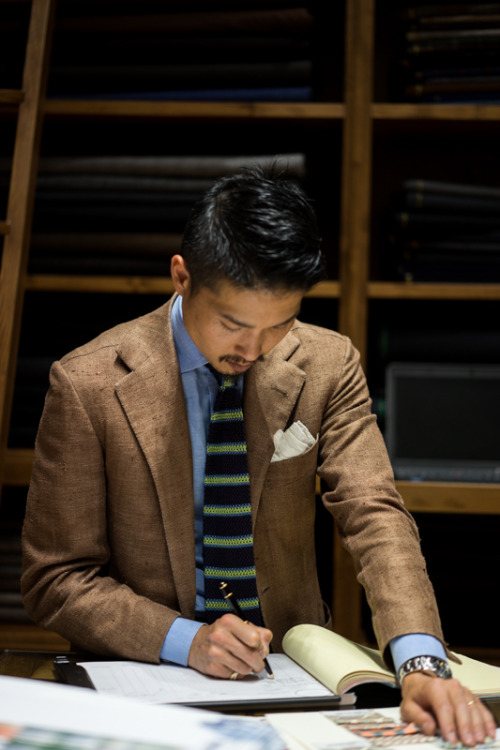
Which is why I like working with small tailoring shops, where the cutter’s name is on the door. You have a better chance of knowing who cut each of the garments that carries the shop’s label. One such cutter-run firm is Steven Hitchcock’s, who’s been in the tailoring business for over twenty-seven years. He left school at age sixteen to find a trade, first puttering around with the idea of becoming a mechanic (he even took some classes for it). “At some point, my grandfather suggested I spend a day with my dad, John Hitchcock, who at the time was a trouser cutter at Anderson & Sheppard,” says Steven. “It ended up being fantastic. I thoroughly enjoyed seeing a pair of trousers get cut and made, as well as celebrities such as Liam Neeson walk through those doors.”

Keep reading

That Sleepy British Look

image


No one in the fashion industry ever admits to being in the fashion industry. For all the designers and tailors I’ve spoken to over the years, I’ve found they all say the same thing – they’re not interested in fashion, they don’t follow trends, and they’re about making things that last. That’s true whether they’re hand tailoring three-piece suits or slapping together the cheapest possible black double rider. 

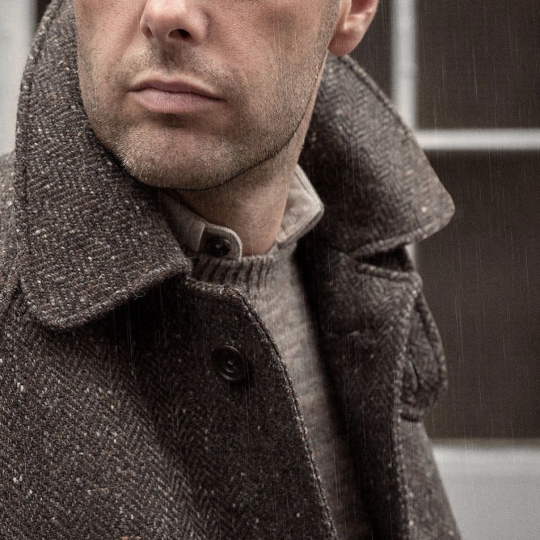
No brand, however, embodies the anti-fashion ethos more than S.E.H. Kelly, a micro-sized brand run by just two people – Sara E. H. Kelly, after which the company is named, and her partner Paul Vincent. Their collections are small, albeit growing, with just a few designs and some basics to accompany them. There are some mid-weight, medium-wale corduroy shirts, including some pullovers with unusual collars, as well as subtly pleated trousers with buckle-back and side-tab details. The stars of the collection tend to be in outerwear, where you’ll find trench coats made from stealth-quality Ventile cotton, as well as raglan-sleeved Balmacaans constructed from the loveliest Donegal tweeds. 

Their collection mostly stays the same from year to year, with a new design dropping once in a blue moon. "When Sara and I started the company, we wanted to do this on an ‘as-and-when’ basis,” says Paul. “Meaning, as we develop new patterns and when we find interesting cloths. Five years ago, we only had three jackets, and the following year, we didn’t have anything new, so we reintroduced the old designs in new fabrics. Now the collection is growing, so we occasionally rotate things in and out, but we still mostly make things with slight updates.”

Keep reading

Looking Like a Japanese Hiker

image

Back in the early 1940s, Leon Leonwood Bean – founder of L.L. Bean – wrote a practical guide on living in the great outdoors. The point of the book, he wrote, is not to “bore readers with personal yarns and experiences, but to give definite information in the fewest words possible on how to hunt, fish, and camp.” The book, while not that well edited, is tightly packaged into 104 pages. It also covers everything from building beds to cooking outdoors to finding lost hunters. You can find it these days through Amazon (it makes for a nice gift for outdoor enthusiasts), although it’s also available for a free read through Google Books

Naturally, for the purposes of this blog, the most interesting section is chapter twelve, which covers what to wear when you’re out in the hills. Leon Bean suggests taking along a pair of 12″ leather top rubbers (what I assume are his Bean boots) and shorter 6.5″ moccasins for dry days, when you’re out on the ridge before it starts snowing. Pants should be medium-weight wools built with knitted or zippered bottoms; outerwear ought to include a medium-weight, all wool coat with a game pocket at the back; shirts should likewise be made from wool, with at least one being a red paid in case “you go out to drag a deer without a coat” (that way, you won’t be shot by other hunters.) A sign of his times, Bean suggests leaving the house with your heaviest business suit. And for handkerchiefs, he says to take along six red bandanas (never anything white). “I also recommend colored toilet paper,” he writes. 

The excerpt is charming, and even if it’s a bit antiquated, it nicely describes a sort of autumn style that still feels relevant today. To be sure, outdoor clothing has always defined fall wardrobes, whether that’s tweed sport coats worn out in English countrysides or the sort of workwear Bean favored. For me, a big inspiration at the moment is Japanese hiking gear – a little more casual than traditional tailoring, a touch less rugged than shooting apparel. No less outdoorsy. 

Keep reading

Splitting the Difference

image


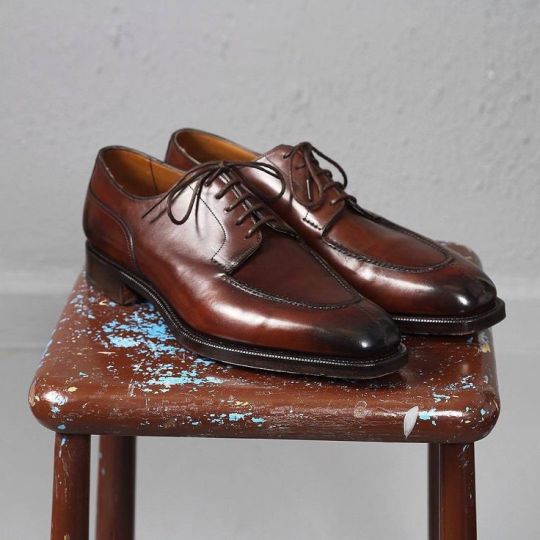
It’s easy to fall in love with a pair of oxfords, particularly if you’re browsing for shoes online. They’re naturally sleek, with minimally detailed uppers that give the shoes a sense of formality. And for many people, dressing up is the same as dressing well. Derbies by comparison can get lost in the mix, but I find them infinitely more practical. Like most men, I rarely wear suits. And for daily use, oxfords just look off to me with sport coats and trousers – even worse with jeans. They’re simply too formal. 

When it comes to derbies, none make my heart pitter patter as much as the Norwegian split toe. I love them for both their design and how much they repulse others. It’s true they can look a bit taxidermic. And if done poorly, an elongated toe seam can even seem phallic. When everything comes together well, however, nothing looks as good to me. Wingtips are too common; cap toes too plain. Norwegian split toes plant your feet in the ground and say you like something a little different. 

Apparently, the style has some workwear roots. John Lobb of St. James calls the style a Navvy cut for how they used to be worn by British navigational engineers (or navvies for short). Nicholas Templeman, who used to work as a lastmaker at the company, tells me men used to wear them when they worked on canals, railways, and roads:

Keep reading

Finding the Perfect Pair of Jeans

image


Nothing defines the American fashion experience more than trying to find the perfect pair of blue jeans. They’re the foundation of any wardrobe outside of tailored clothing, the casual equivalent of gray flannel trousers. This old Australian documentary on Levi’s summed it up best: 

The symbols that tell a story in a twinkling of an eye are usually everyday products, but some are very special. The Eiffel Tower says France, but the little Sony walkman says Japan. The archetypal symbols that yell America are the Coke bottle and Levi’s Strauss jeans. They all enjoy the prestige of being regarded as design classics. […] Film stars, American presidents, student protestors, and rock musicians have all worn the 501. From gold mining through protest, to what they are today, [blue jeans] are the story of the acceptable uniform for non-conformity. 

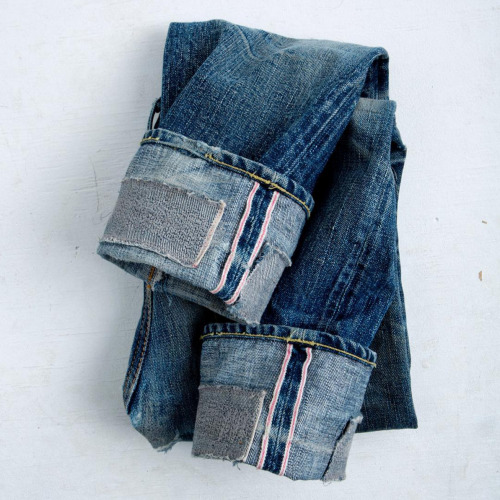
Some men look great wearing tailored clothing year-round, but I can’t imagine building a wardrobe without blue jeans. They’re practical, hard wearing, and frankly look great. Even Bruce Boyer, the closest thing we have today to an arbiter elegantiarum in classic menswear, occasionally wears a pair. Over the years, I’ve cycled through at least a dozen models trying to find the Platonic ideal. The truth is the perfect pair of jeans doesn’t exist – a lot depends on what other clothes you like to wear. Here are ten models, however, that I think are notable. 

Keep reading

On Developing Personal Style

image


So, I’ve been working on a two-part series for Put This On (for those who don’t know, most of my writing is there). The posts were inspired by an online Vogue article I read earlier this year. Apparently, fashion editors are just like the rest of us. Despite having closets overflowing with options, they mostly rely on the same things for their day-to-day routines. An excerpt:

Like an exploding volcano of denim and satin, a tidal wave of cashmere and cotton, our clothes threaten to overtake our tiny apartments, to bury us alive under tees and trousers. This wouldn’t be so bad, maybe, if we actually wore all this stuff, if 365 days meant 365 different outfits—730 if we changed for evening! But nooo. In fact, most of us rely on a few favorites in serious rotation, leaving the rest of the orphans in the closet begging for crumbs.

To judge just how severe this situation has become, and with spring in full flower and the temptation to buy still more!—more!—beckoning from every shop and laptop, I asked some of my Vogue colleagues to share with me what it is they actually wear from their bursting closets.

Keep reading

David Kind, A New Kind of Luxury

image


It’s been about ten years since fashion journalist Dana Thomas penned Deluxe. And today, it stands as one of the best books I’ve read on the rise and fall of luxury labels such as Prada and Louis Vuitton. The book is about how the constant search for higher profits has led many old-world luxury companies to give up things that made them special in the first place – a commitment to quality, a focus on craft, and a willingness to innovate in terms of design. It’s not hard to notice that, for consumers in Western Europe, North America, and Japan, these labels have become less and less relevant over the years. 

It’s hard, however, to identify what’s replacing them. My friend Paul Munford, who runs the very smart Leanluxe, likes to say modern luxury companies are centered around a quiet confidence in branding, virtue of product, specialization, and transparency. Think of companies such as Ledbury, Common Projects, and Tracksmith

Perhaps. Sometimes I think Paul’s focus is more driven by aesthetic differentiation (e.g. minimalist branding) than actual business models. Plus, luxury is inherently hard to define. The people who were buying Louis Vuittion a generation ago may not be the same people buying Ledbury today. At the same time, that may not matter, as it’s clear a shift is happening. Mr. Porter, for example, is very much a luxury shop – and they don’t carry many of those old world brands. 

Keep reading

Why Buy Handmade Goods?

image


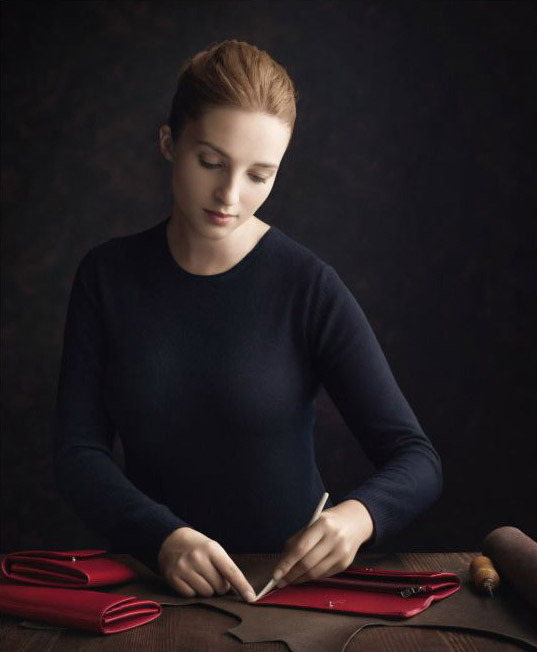
In the spring of 2010, the U.K.’s Advertising Standards Authority banned two Louis Vuitton print advertisements because they suggested the company’s products were handmade, when in fact they were not. The ads showed two softly illuminated women acting as master artisans (they were oddly in their mid-20s, by the way). In one image, a women is pictured saddle stitching a bag’s handle, while in another, a woman makes a fold on a wallet. Underneath, the copy reads: “A needle, linen thread, beeswax and infinite patience protect each overstitch from humidity and the passage of time […] With so much attention lavished on every one, should we only call them details?” The other says, “What secret little gestures do our craftsmen discreetly pass on? Let’s allow these mysteries to hang in the air. Time will provide the answers.” The images strangely looked like Johannes Vermeer’s paintings from the 17th century. They felt quiet and serene, and evoked a sense of old European craftsmanship that Louis Vuitton would have you believe goes into their mass-market bags.

On the one hand, these might not seem too different from ads with Photoshopped models and carefully staged settings. On the other hand, the issue of craftsmanship is much more tangible than brand imaging. People consciously make decisions on whether they’ll purchase something based on how it was made, and it’s commonly believed that handcrafted goods are better made than machined ones.

Is there something special about handmade goods, however? Many have thought so. The signs of handwork are a craftsman’s fingerprints, and people have valued craftsmen at different times for different reasons. Greeks and Romans thought of human labor as heroic. Hesiod’s Works and Days and Virgil’s Georgics, for example, portrayed human labor as divine and glorious. Additionally, painters in the 17th and 18th centuries often depicted people finding quiet satisfaction in their labor, and thinkers during the Enlightenment saw craftsmen as emblems of human individuality. Manual labor was placed as being equal to mental labors, and useful work was thought to be the driver of human progress.

Keep reading

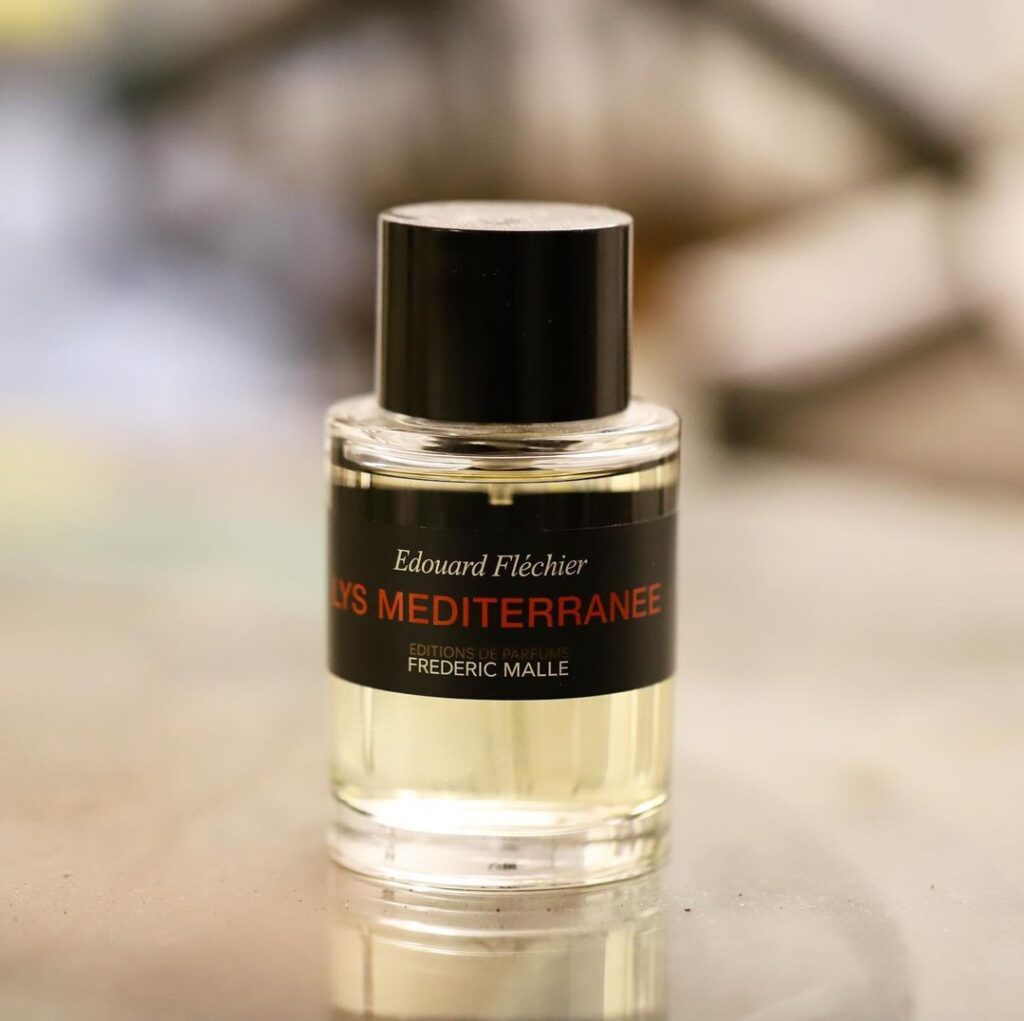
Frederic Malle, The Scent of Summer

Even people who say they don’t like fragrances will use them a dozen times a day. Fragrances are in our shaving products, creams, lotions, antiperspirants, shampoos, etc. I’ve always thought this is one of the reasons why fall/ winter scents can be more interesting, but spring/ summer fragrances are easier to wear. Whereas cooler weather scents rely on notes such as woods, spices, and leathers, their warmer weather cousins typically revolve around citruses. Think of the citrus-wood accord of Terre d’Hermes or the citrus-aquatic pairing of Creed’s Green Irish Tweed

Citrus smells fresh and clean, which is why it’s instinctually appealing and used in everything from mouthwash to detergents. When you come across mainstream, designer fragrances, you’ll often find citrus packed into the opening, even if the molecules mostly disappear after fifteen minutes. Manufacturers know people make their purchase decision within minutes of testing a scent on a paper strip. Few will ever spray the fragrance on their skin and see how it develops over time – they just need to smell that bright citrus in the beginning to pull out their wallets. 

I like citrus-based scents, but one of my favorite fragrance houses this year is Frederic Malle, who I think does warm weather scents especially well. And their fragrances are a lot more nuanced than just citrus. 

Keep reading

One More Run of Summer Tweed

image


Designing cloth has become one of my favorite aspects of running this blog. It’s great to see a cloth materialize, after months of planning, and then see readers send their lengths to tailors, so they can be turned into suits and sport coats. In the past, I’ve put together special edition runs of tobacco brown Fresco, navy houndstooth Fresco, and a silk-linen blend I call “summer tweed.” The last one is my favorite. 

It’s also apparently a favorite of readers. In the last year, I’ve gotten more emails about this one than any others. Those who subscribed have written in to say how much they like their fabrics (and the resulting jackets they had made). Those who missed out have asked if the cloth will ever be offered again. 

So, I’m doing one more run of this fabric – this time with a special collaboration with Sartoria Formosa (more on that below). 

Keep reading