A warm, heartfelt thank you to everyone who nominated me for “Best in Media” in this year’s Permanent Style awards. To be honest, I was surprised to see my name come up even once, and the fact that this award was given through a popular vote means a lot to me. By the end of the voting period, I did feel vaguely horrified for Simon, knowing he’d have to write the words “Die, Workwear!” on his otherwise beautiful site. Mine is easily the worst name for a blog – let alone one about workwear. Still, Simon was nice enough to do an interview with me about winning the award, which you can read here.
While I’m at it, I should say most of my writing is at Put This On, and I’m really proud of the work my colleagues do there. We’ve been working for months – months – on a re-launch. Fingers crossed, the new website will go up in February and I think it’ll be something special.
In the meantime, I promise to work tirelessly to bring you quality content on bespoke tailors almost none of us have access to, as well as Japanese products that look identical to things available in the United States, but require going through a Byzantine labyrinth of proxy services to buy. Thanks again for your support (genuinely).
Even with the explosion of online media nowadays for men’s clothing, it can be a challenge to find good, relatable content for how to wear a coat-and-tie. Much of what’s celebrated online is too aggressively styled for most offices – tightly cut suits, heavily patterned fabrics, and unusual accessories. Great for Instagram and menswear blogs, but less so for the day-to-day grind of most people’s lives.
Which is why it was such a pleasure for me to talk with Mr. Kazuto Yamaki. He’s the CEO of Sigma, a Japanese manufacturer of camera lenses, flashes, and other photographic accessories. He’s also an exceptionally well-dressed public figure, but so far removed from the world of menswear blogs that I had to try a few times to convince him that I was not, in fact, joking when I said I wanted to interview him about how he dresses.
Much of what Mr. Yamaki wears will be familiar to anyone who reads this site – softly tailored Italian-influenced suits and sport coats, paired with tastefully designed ties and solid colored dress shirts. Where I think he makes a distinction is that everything looks relatable, something you can wear to most offices today. It’s thoughtfully considered without being obsessive; informed without nit picking. And in being so, it looks more naturally put together.
The Japanese are often presented online as being masters of their craft. The toiling shoemaker who’s a bit more meticulous and focused than his European counterparts, producing things to the highest level of quality. There’s a strange and sometimes unsettling strand of Orientalism that runs through these narratives, but if there’s anything that can be said of Japanese production, I find it’s more about design.
Japanese companies are tremendously good at design, especially if you have a penchant for classic clothing but want something that feels relevant and updated. Kaptain Sunshine, one of my favorite casualwear labels as of late, is something like a quirkier version of LL Bean. The designs are a little more creative; a little more daring. The silhouettes and details are playful in just the right ways, making them more than just literal reproductions from history.
The same can be said of bags. Before the heritage revival in the US went mainstream – encouraging companies to dust off their archives – Japanese brands were already making their versions of the 1970s-style hiking backpacks, helmet bags, and classic carryalls. If you want a casual bag, it’s worth looking towards Japan. These can be expensive, ranging anywhere from $150 on sale to a whooping $1,000 at full retail, but the designs go a little further than your basic Jansport. And while similarly priced US options are just as nicely made, they’re often too technical – sacrificing form for function.
My friend Reginald-Jerome de Mans recently wrote a review on Adolf Loos’ short volume of collected essays, titled Why a Man Should be Well-Dressed. Loos was an influential European architect at the turn of the 20th century, whose main work foreshadowed modernism in architecture and design. In his spare time, he opined on men’s fashion in cantankerous ways. Frankly, I found his book to be one of the worst I’ve read, although RJ feels otherwise (his review is infinitely better than the book itself). That said, I agree with the opening of RJ’s essay: “I love a book whose author dares to assert a viewpoint. In clothing, this means more than simply asserting ‘style is eternal’ or ‘nice clothes are nice,’ as most books on the subject seem to do.”
So, in that spirit, I’ll dare to assert a viewpoint: I find some coats look better worn open, and others better closed. And to the degree that anything can be generalized, the ones that look better open tend to be single-breasted. Double-breasted coats can be worn either way, but the fullness of the front lends itself to being fastened. This is true of everything from dress outerwear to more causal parkas and leather jackets.
I mentioned this offhandedly last year on StyleForum and received a ton of pushback. Frankly, I hadn’t even realized that the view could be controversial – that coats don’t always look equally good both ways. That there’s a difference in how things can look when styled, and this is worth considering when choosing what to wear for the day. I find single-breasted coats to be best for cooler autumnal days; double-breasted to be better if you need something very thick and warm for winter. If the weather is so cold that you think you’ll need to keep covered most of the time, a double-breasted overcoat is going to look better than a single-breasted one.
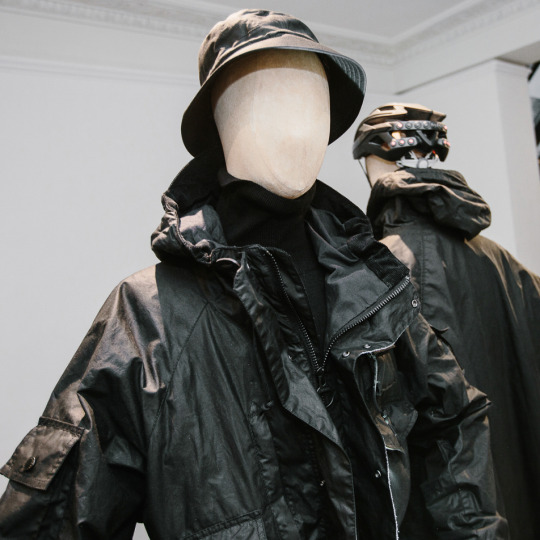
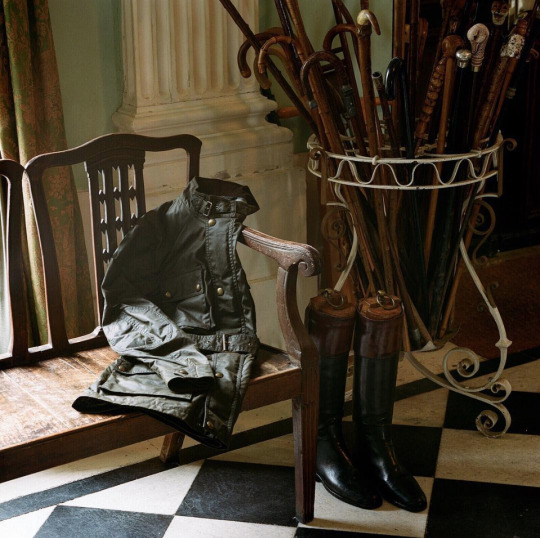
Barbour holds a special place in my heart, but from their expansive collection, the only pieces I wear are the Bedale and Beaufort. The first is a waxed cotton jacket with ribbed storm cuffs, which is great for layering over sweaters; the second is similar, but a little longer so you can comfortably wear it over sport coats. This fall, however, they’re introducing a special collaboration with Daiki Suzuki of Engineered Garments and I couldn’t be more excited. The collection was recently unveiled this past Saturday at London Men’s Fashion Week, although the jackets won’t be available for sale until fall. If you couldn’t wait for last year to be over, this collection is a good reason to pine for the end of this one.
Each jacket is made from Barbour’s signature waxed cottons, in neutral colors such as olive, black, and navy. Waxed cotton, as many know, is one of the more traditional forms of water-resistant fabrics, but unlike others, it develops a unique patina over time. Before British sportsmen wore the material to cover themselves from the rain, British sailors covered their capes in grease in order to protect themselves from the sea’s sprays.
Daiki Suzuki says Barbour reached out to him for the collaboration, and given how much he already draws from hunting clothes, the partnership was natural. “I personally love Barbour and hold in my collection a Bedale, Beaufort, International, Cowen Commando and vintage reissued cape given to me by WP Lavori,” he said. “One of the main elements of Engineered Garments is its classic military styling. It was a challenge to think about how to go about working with such an iconic brand and one that I hold dearly."
Mr. Porter just made their second round of markdowns. It’s still pretty early into the sale, so not all the product pages have been updated yet. However, you’ll see the newly adjusted prices when you take things to checkout. I imagine the prices on the product pages will be updated in the next couple of hours.
At the moment, select items are discounted by as much as 70% off. And, surprisingly, there’s still a lot of stuff left. The key at this point in the sale is to just browse the sale section and filter by garment type and size. That way you can stumble upon some good finds while not wasting time hopping from brand page to brand page. Note, Mr. Porter’s sale at this point moves very fast, so be aware when considering something. Google Chrome can also be a bit buggy sometimes on the site, so switch to another browser if you experience problems.
Everyone’s favorite sale of the season, Mr. Porter’s, just started. The sale isn’t advertised on the homepage yet, but you can see prices already marked down on select items (just browse around). If history is any indication, more items will be marked down as the night moves on. And by tomorrow morning, the entire sales inventory will be up.
Things here tend to move fast – very fast – but I’ll be updating this post in the next half hour with some of my favorite finds. If you’re having trouble accessing the sale, use a browser other than Google Chrome. For whatever reason, Chrome occasionally glitches on Mr. Porter’s site.
The next week or two are going to be big for end-of-season sales. Some are just starting to roll in, although at least one store (End) is on their second round of markdowns. I’ll be rounding up some of my favorite sales over the next week, but here are five this weekend worth checking out.
End:The thing to remember about End is that they’re located in the UK, which means that listed prices tend to be about ~20% lower than what you’ll find at most other shops (since they automatically deduct for VAT). Add to that their current 50% off promotion and things become pretty sweet.
There are two often-recited stories for how tweed got its name. The first is that it was originally a misreading of tweel – an old Scottish word for twill – which was supposedly written on an invoice somewhere. How that misreading eventually made it into the more general vernacular, nobody knows, but it’s probably the pithiness of the story that counts. The other guess is that the word tweed refers to how the cloth originally came from the valley of the River Tweed. That, to me, seems like the more likely reason. Many of the ancient names we have for fabrics are derived from the places where the material was often made – cashmere for Kashmir (India), muslin for Mosul (Iraq), worsted for Worstead (England), cambric for Cambrai (France), and the endlessly cited denim for de Nimes (also France). In many ways, the names we have for fabrics today tell a story about earlier waves of globalization.
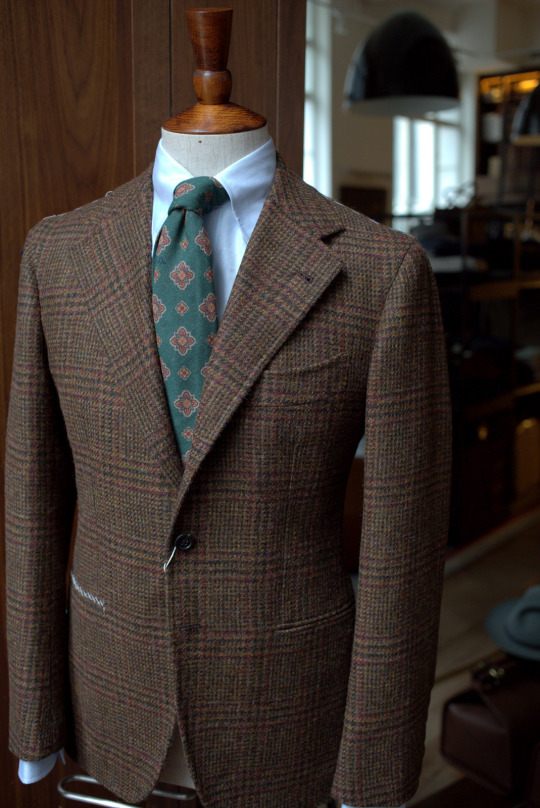
For all the histories we have about tweed, however, few people really know what defines the cloth. It’s one of those “you know it, when you see it” type materials. Prickly in texture and earthy in color, it’s the fabric of fall and winter. It somehow manages to be one of the least and most comfortable materials you can wear. Least in the sense that it’s often too scratchy and rough to be worn against bare skin, which is why it feels and looks better when layered over thicker dress shirts – oxford cloth button downs or brushed cotton flannels. Tweed trousers, if you have occasion to wear them, often need to be fully lined. At the same time, tweed has an undeniably comforting quality to it. It’s hardy and reliable; sturdy and flattering. In a genuinely classic cut, a tweed jacket is something you can wear for the rest of your life.
The best definition of tweed is a kind of negative definition – a way to understand to cloth by what it is not, rather than what it is. Tweed is one of the oldest, if not the oldest, of British textiles. Before the advent of modern loom technology, European fabrics were stiff and heavy. City fabrics (such as those that would be worn in London) were naturally more refined than country cloths, but they were still more substantial than the Super 100s you’ll find in stores today. Scottish fabrics were rougher still. After the union of the two kingdoms, an economic board was set up to organize and encourage the cottage industries around Scotland. Among those were tweed weavers, who for centuries, made workwear fabrics designed for heavy use out on the countryside.
A few years ago, British writer Alain de Botton penned an essay on why we hate cheap things. His point was simple: we don’t think we’re snobs, but we often behave like we are. We conflate worth with price and assume cheap things can’t be any good – after all, there must be a reason why they’re cheap. And in doing so, we miss many of the more common pleasures surrounding us.
His essay starts with the story of the pineapple. Once a rare and exotic fruit, pineapples were difficult to cultivate and even more difficult to transport. In the 17th century, a single pineapple would cost about $7,500 in today’s dollars. Only royalty could afford to eat it. Russia’s Catherine the Great was a big fan, as was Charles II of England. Grand monuments and buildings were erected in its honor; poems were written about its flavor. If you were so lucky to get a pineapple, you’d put it on your mantle until it rotted and fell apart. Pineapples were a luxury, even a status symbol.
Then, at the end of the 19th century, two things happened. First, large commercial plantations were set up closer to the West, such as in Hawaii. Second, the advent of steam ship technology dramatically lowered transportation costs. Today, you can get a pineapple for less than $5 in almost any supermarket, sometimes available in bite-sized pieces contained in see-through boxes. There’s no glamour to pineapples anymore, but it’s not because the fruit has changed – only our attitude towards it.