Ten Amazing Boxing Day Sales

image


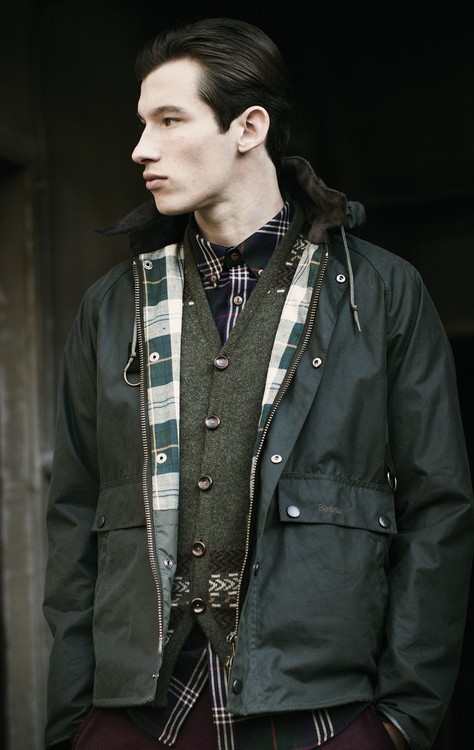
Today is Boxing Day for people in the Commonwealth, as well as the start of end-of-season promotions. I’m rounding up the best seasonal sales at Put This On, but I wanted to pull out my ten favorites here. There are some tremendous deals right now. Mr. Porter, notably, launched their winter sale yesterday, where you can find things such as discounted Edward Green shoes and Schott leather jackes. End has waxed cotton Barbours starting at $175; J. Crew has their anorak discounted to $100, as well as hemp work shirts for a mere $14 (I think tax costs more for most purchases at this point). Brooks Brothers’ oxford button-downs are seeing a rare promotion. And there are some terrific deals on outerwear, from Marni overcoats to Blackmeans double riders

END: Up to 60% Off Select Items

If you’re one of the few people left on this planet that reads about menswear online, but doesn’t own a Barbour jacket, END has some of the best prices around. Their end-of-season promotion includes a wide range of Barbour styles, including the Bedale for $199 and Beaufort for $259. I wear the Bedale over heavy sweaters, but use the longer Beaufort on the rare occasions I layer a Barbour over a sport coat. END also has Barbour’s Ashby, which is a slimmed-up Bedale, for $175. See this Barbour buying guide I wrote years ago for sizing advice.

Keep reading
Better than Wool Flannel Trousers

image


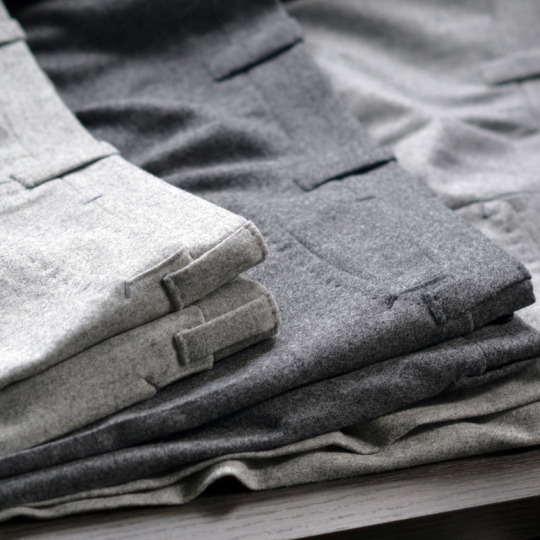
Flannel trousers are the backbone of any tailored wardrobe. They’re professional without looking pushy, sophisticated without being slick. Best of all, while they’re perfectly suitable for the office, they make you feel like you’re lounging in your brushed cotton pajamas. Wool flannel is so soft and comfortable, the Brits used it for undergarments up until the early 20th century. Doctors even recommended wearing flannel to ward off ailments and cure dysentery. Although, not everyone was convinced. In a 1900 issue of The Medical Times, one skeptic wrote: “The writer was a constant victim to colds. He was really a victim of flannels, having fall after fall procured underwear of heavier weight and all wool, in the determination to avoid the chills and shivery sensations during winter. [He fell] for the flannel craze.” 

Like all wool fabrics, flannel comes in two forms: worsted and woolen. Maybe these categories should be renamed to combed and uncombed, however, because it’s the combing process that separates them. Combing wool is exactly what it sounds like. Before wool is spun into yarn, a spinner can separate out the fibers by combing the material. This sets the hairs parallel to each other, as well as removes any of the shorter fibers that would spoil the regularity characteristic of worsted. After the wool has been combed, it’s spun into yarn and then woven into a fabric. And by combing the hairs first, the resulting fabric will feel a bit smoother and crisper, which is how you get shiny, hard-finished fabrics. Woolens, on the other hand, aren’t put through the same process. Thus, the fabric is spongier and loftier, as the fibers point in every possible direction. To give examples, gabardine is worsted; tweeds are generally woolen. 

Flannel is available in both forms. Worsted flannel will have a subtle but visible twill weave just beneath its fuzzy nap. Woolen flannel, on the other hand, tends to look cloudier (like the every-which-way direction of the hairs on tweed). I prefer woolen flannel this time of year because it’s softer and spongier next to the skin, its lofty surface helps trap heat, and its mottled finish lends visual interest. None of these characteristics are present to the same degree in the increasingly more common worsted variety, whose only virtues are that it’s studier and can be woven into a lighter weight material. If you have the money for it, get worsted flannel for spring/ summer, then heavier woolen flannel trousers for those bitingly cold winter nights.

Keep reading

Tailoring for Younger Guys

image


George Frazier, the famous jazz columnist and author of “The Art of Wearing Clothes,” had one of the most accurate and least helpful ways of describing style. He used the term duende, a Spanish word for a kind of mythological hobgoblin, but when used colloquially, at least by Frazier, it refers to a kind of irresistible magnetism. Some things have duende and some things, while they may still be good, simply do not.  

“It’s the thing that Fred Astaire had, but Gene Kelly did not; what made a Ted Williams strikeout more exciting than a Stan Musial home run,” Alex Belth once explained in Esquire. “It was difficult to even describe – you just knew it when you saw it – but Frazier never tired of trying. For him, style was a matter of utmost importance, as he revealed in a 1969 column: ‘It is my own conviction that there can be no style without … an immense honesty, and inviolability in the matter of one’s craft, a relentless being-true-to-one’s-own image.’”

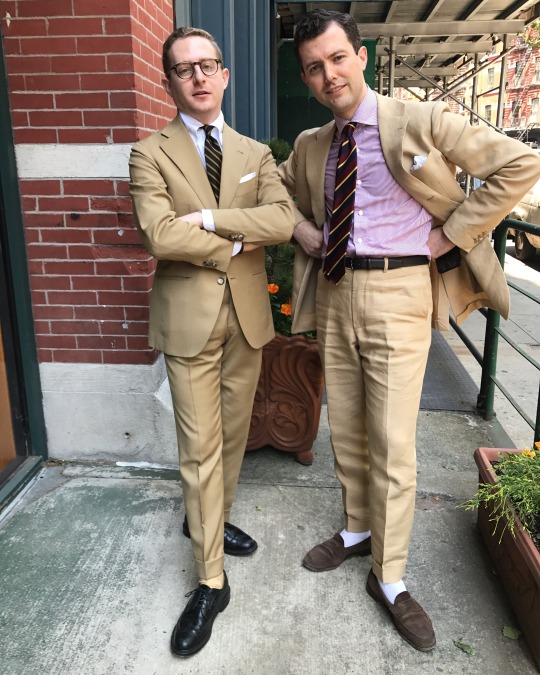
Duende goes by many other names – it’s similar to sprezzatura in Italian and sang-froid in French. In any language, it points to a kind of naturalness that can’t be imitated. And after chatting with Dick and Ben for a couple of hours last week, trying to get at some helpful tips on how others may want to dress, I left with little practical advice. Dick and Ben wear many of the same things others do, they just look cooler.

Keep reading

Are Fashion Seasons Outdated?

image


When did you start wearing tweed and flannel on a consistent basis this year? About a generation or two ago, these two robust fabrics would have made their first appearance after Labor Day, which marked the natural end of summer fashion. After all, that was the spirit behind the saying “no white after Labor Day,” a rule so sacred among etiquette hardliners that Patty Hearst’s character was murdered for it as punishment in the 1994 movie Serial Mom. But this year, my autumnal clothes have been dashing in-and-out of my wardrobe, with summer pieces continuing to be useful as late as November. Last month, thirteen US federal agencies released a stunning report saying climate change has already had devastating impacts on our health and economy. On a more superficial level, I can’t help but wonder if it’s also affected our wardrobes – and menswear retailing. 

Every year, the traditional concept of four seasons seems increasingly outdated. Scientists have found that, as the planet warms up, the tropics have been expanding 0.1 to 0.2 degrees latitude every decade, so that places that once had four seasons are now shifting to having just two. Vox had an article this week about how global warming could change US cities by the year 2050 (“In some cities, it’ll be like moving two states south”). “You can see that Scranton, Pennsylvania, will have a climate that resembles that of Round Hill, Virginia, today,” they wrote. “That’s a distance of about 220 miles as the crow flies, but it means that Scranton will face average summer peaks that are 4.8°F higher and winter temperature lows that are 5.5°F higher.” 

This is happening all over the place, not just in Scranton. In parts of New England, winters have warmed at an average rate of more than 1°F per decade since 1970 — that’s more than 4°F total. Last year, some eastern US cities were beset with summerlike temperatures as early as February. And across the US, winters feel shorter and generally milder, with the transition from cold winter weather to warmer spring temps happening earlier. Alexander Stine, an Assistant Professor of Earth & Climate Sciences at Harvard, says: “Once we account for the fact that the average temperature for any given year is increasing, we find that some months have been warming more than others. Most of the difference is the result of this shift in the timing of the seasons, and a decrease in the difference between summer and winter temperatures.”

Keep reading

Ten Early Black Friday Sales

image


Black Friday sales are upon us. Every year, I roundup some of my favorites both here and at Put This On (we’ll have a comprehensive list of every worthwhile sale later this week, on Friday). Some stores, however, are getting a jump on things. Many have already started their Black Friday promotions, with discounts going as deep as 50% off. There’s even a topcoat below for just $150. From affordable workwear to contemporary casualwear, here are nine really good early-bird specials. 

J. Crew: 50% Off, Code TGIF

J. Crew’s never-ending sales have become a running joke on Twitter, but I also think their Wallace & Barnes line is one of the best values in menswear right now. Their clothes have a more boutique feel than J. Crew’s mainline, are made from better materials, and are inspired by the company’s vintage design archive. Wallace & Barnes is great even at full retail, but with the current promotion, it almost feels like you’re shopping in 2009 again, before fashion prices were launched into outer space. This indigo moleskin chore coat, for example, is just $130. Their autumnal Fair Isle sweaters are $74; terrycloth sweatshirt $40; heavyweight flannel and hearty herringbone work shirt less than $50. This olive green, cotton-hemp shirt is kind of basic, but also just $27. 

Keep reading

The Most Flattering Sweater?

image


Back in 1996, Tom Junod wrote a piece for GQ Magazine, which was nominated for a National Magazine Award. Simply titled “My Father’s Fashion Tips,” it was about his father’s impeccable style, as well as the opinions of a man who felt strongly about clothes. The article is a wonderful read, and even includes some rules for underwear, but the best part is his father’s unwavering confidence that a turtleneck is the most flattering thing a man can wear – an inflexible and enduring axiom that, Tom writes, his father believed in more than the existence of God. 

Anytime my father wears a turtleneck, he is advancing a cause, and the cause is himself. That is what he means when he says that an article of clothing is “flattering.” That is where his maxim extolling the turtleneck acquires its Euclidean certainty. The turtleneck is the most flattering thing a man can wear because it strips a man down to himself – because it forces a man to project himself. The turtleneck does not decorate, like a tie, or augment, like a sport coat, or in any way distract from what my father calls a man’s “presentation;” rather, it fits a man in sharp relief and puts his face on a pedestal – first literally, then figuratively. It is about isolation, the turtleneck is; it is about essences and first causes; it is about the body and the face, and that’s all it’s about; and when worn by Lou Junod, it is about Lou Junod. 

Every year around this time, fashion writers try to convince us that the turtleneck is, in fact, finally coming back. You can take this to mean that they are always in style or never quite in, although it’s probably a mix of both. Turtlenecks teeter on the edge of men’s closets. They’re viewed with as much suspicion as they are with interest

Keep reading

Looking for a Shear Thing

image


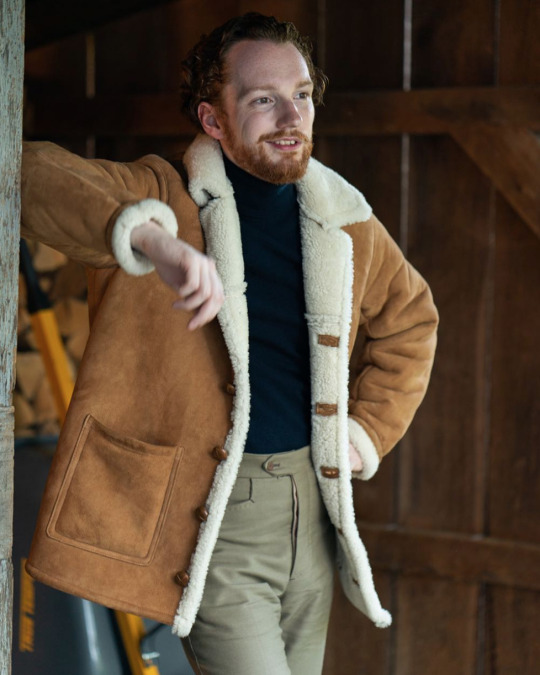
When it comes to outerwear, few styles come pre-loaded with as much meaning as a shearling. Not too long ago, the mere mention of it evoked images of the Marlboro Man. Those long, bulky, no-nonsense coats that have patchwork seams running up-and-down the back, and tufts of wool peeking out from beneath the cuffs. The silhouettes are blocky; the leathers often dry and cracked. They make their wearers look like King Kong. 

There have been times, however, when shearlings were considerably more luxurious – even if questionable in taste. In the early 1930s, catalog retailers advertised shearling coats alongside suede leather jackets and horsehide outerwear, seemingly unaware of the Great Depression. The material came roaring back in the ‘70s with the Peacock Revolution. Swanky men wore them with chunky turtlenecks and velvet bellbottoms, presumably to their eternal regret years later. They’ve also been part of some important rebel uniforms, including the better side of skinheads (e.g. the non-racist kind) and French zazous (who were an anti-establishment, punk version of French dandies). 


Keep reading

A Literally Sick Outfit

image


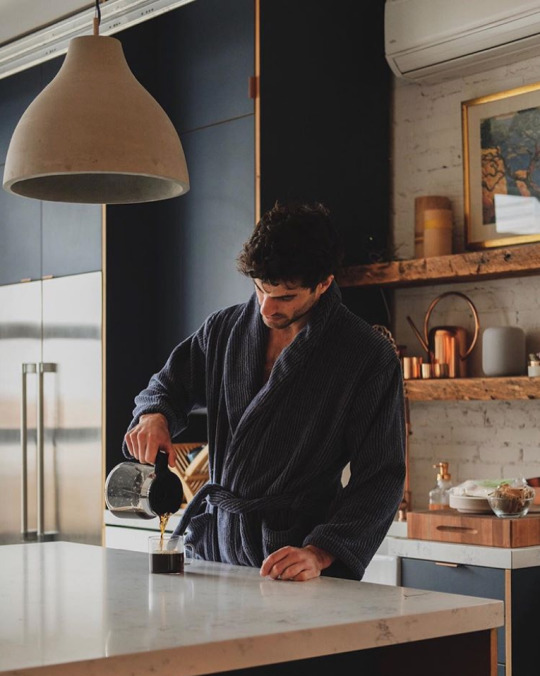
Winter style is often presented as sled riding through some New England forest, or enjoying a hearth redolent of roasting Indian corn, but reality is often less romantic. This time of year is flu season, which means for many people, winter at some point will be about Robitussin, hot tea, blankets, and cough drops. I’ve been holed up at home for the past few days trying to fight off a stubborn cold, stay warm, and sleep through the night despite fits of coughing. 

Nothing will cure a cold except time, but there are things you can do to make yourself feel better. The Chinese have an herbal remedy called Nin Jiom Pei Pa Koa, which does wonders for a sore throat, even if it tastes awful (I drink hot water mixed with a scoop of honey instead). Nasal sprays can help manage congestion, although you don’t want to use them for more than three days in a row. And wearing good loungewear feels so much better than laying around in sweatpants and a t-shirt. 

Years ago, Jacob Gallagher at The Wall Street Journal wrote a piece exploring whether men still wear pajamas. There aren’t many, and among those who do, some are apparently trying to sell others a set (Andy Spade, one of the founders behind Sleepy Jones, was quoted). The reasons given for PJs were predictable – they confer a better sense of self-respect when you’re at home (I have none to begin with, so that matters little), and they allow you to look presentable should an unexpected guest drop by (I have no social life, so that matters even less). 

Keep reading

No Man Walks Alone Anniversary Sale

image


No Man Walks Alone is an advertiser on this site, but also one of my favorite stores. In the last ten years, the average menswear shopper has become a lot more sophisticated – they know just as much about Neapolitan tailoring as they do about directional casualwear. No Man Walks Alone serves that kind of customer. They have classic suits and sport coats, but also interesting clothes for the weekend. It’s one of the few shops where a guy can pick up a wardrobe for almost any part of his life. 

This weekend marks their fifth year of doing business, and to celebrate, they’re holding a sale. For the next five days, you can take 20% off any order with the checkout code 5YEAR. The code even works on already-discounted sale items. Here are ten things I think are particularly worth a look:


Keep reading

Easing into a Cold-Weather Wardrobe

image


Much of men’s style takes after British tailoring, when dress norms were set during a different time period and climate. This is why, when we imagine a fall wardrobe, we think of the kind of heavy tweeds and wool overcoats that used to be seen in periodicals such as Apparel Arts. And yet, today, the cold season has been noticeably pushed back – late September still feels like summer and we’re months away from heavy outerwear weather. The biggest challenge for dressing this time of year is managing the wide temperature swings that can bring warm afternoons into chilly nights. Back when he was still writing about men’s style, Will Boehlke used to call this “shoulder season.”

It’s easy to dress well for early autumn if you rely on suits and sport coats. Instead of lightweight Frescos and linens, you want jackets in ribbed corduroys, mid-weight tweeds (nothing too heavy), and worsted wools. Worsted is just another way of saying the wool fibers were combed before they were spun into yarn, which makes the resulting fabric a little smoother and clearer finished (as opposed to woolens, which are left uncombed and are consequently spongier). 

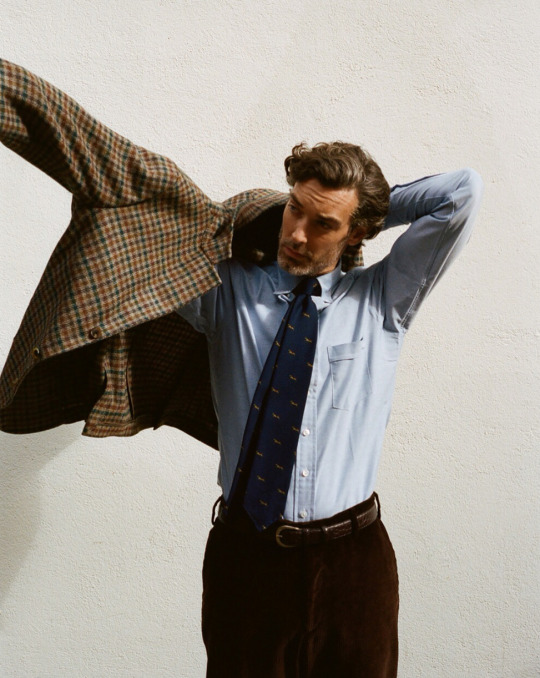
There’s also a class of fabrics colloquially referred to as faux or citified tweeds. These are smooth, tightly woven worsteds made in rustic patterns reminiscent of traditional checks. They carry the distinctive colors and patterns of Scottish estates, as well as the tonal range best associated with the British countryside – bark, moss, and heather. They wear warmer than true summer fabrics, but don’t trap as much heat as real tweeds. Which is to say that they fit exactly in the middle. A couple of faux tweeds, along with a heavier navy sport coat in hopsack, serge, or this Sportex, and you’d have your early-fall tailored wardrobe covered. 

Keep reading