The Golden Age of Motorcycle Jackets

image


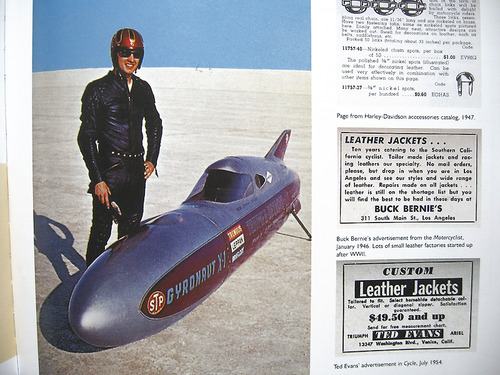
If you’ve ever caught yourself admiring a leather motorcycle jacket, you’ll love these photos. These were taken from Rin Tanaka’s book Motorcycle Jackets: A Century of Leather Design. Tuesday had a post about the “Pre-Dawn” and “Sport Jacket” eras. Today’s is about “The Golden Age” of motorcycle jacket design.

The Golden Age is short - starting just after the war in 1945 and ending in the mid-1950s. Jackets in this period were characterized by a “W” collar, bi-swing or full-swing back, and a kidney panel “action back” with belt loops. Details that we only saw glimpses of in the Pre-Dawn and Sport Jacket eras became staples in this period. The fronts were always closed with zippers (usually Talon or Conmar, although Crown’s were the best). Sleeves were also zippered, epaulets were usually present (some decorated with spot work), and holster-shaped double pockets on the front were a common feature. And where most leather jackets before were brown, we see the emergence of the black leather jacket in The Golden Age. This is essentially the period that defined what we think of as the “quintessential motorcycle jacket”- a kind of design that was immortalized by Marlon Brando’s performance in The Wild One

Tanaka’s chapter on The Golden Age is organized by manufacturer, and it starts, rightfully, with Harley Davidson. One of their best jackets between the early to late 1940s was this model called the “Cycle Champ. You can see iterations of it here (note, these are all horsehide). 


Keep reading
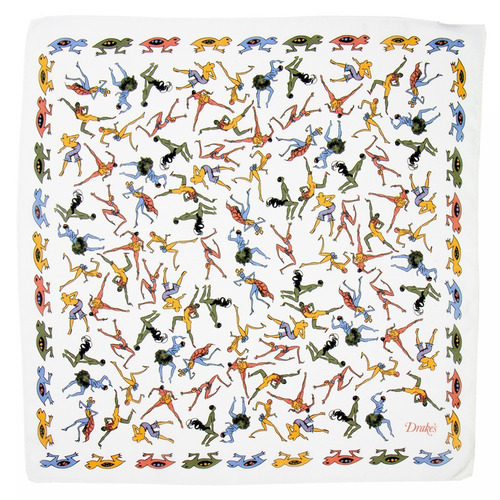
Josephine Baker Pocket Squares

image


In happy weekend news, Drake’s full spring/ summer collection is now available on their website. Included are some summer shirts made in their newly acquired Rayner & Sturges factory, as well as some ready-to-wear sunglasses from Nackymade. They’ve also expanded their colors for grenadines (now boasting many shades of green, brown, and blue) and broadened their line of shantungs. In addition, the unique fuzzy mohair tie they introduced last season seems to have been kept, and there are some basic repp stripes to satisfy their more conservative customers.

Perhaps most interesting of all is their pocket square line. There’s a handsome cotton animal print that I think would sit well in the pocket of any tropical wool or linen sport coat, as well as a spring/ summer version of their tile print design. I actually bought a couple of their tile prints last season and have found them to be incredibly useful. The print is unusual enough to not overly match any tie, but also conservative enough to not stick out too much on its own.

The best square of all might be the one honoring Josephine Baker – widely considered the “First Lady” of jazz and an important figure in the American Civil Rights Movement. Baker famously refused to perform for segregated audiences in the US, and had a not uncomplicated relationship with French society as a symbol of Black femininity. I’ve included a great documentary on her at the end of this post, should you want to watch some fascinating Black history. There are also some things over at The Phoenix Project dedicated to her, although those are aimed at women’s wear. 

Many thanks to Drake’s for not releasing a line of Bill Evans or Miles Davis pocket squares this season, for otherwise, I might have gone broke. 

Keep reading

Unfortunately, They’re Not That Floppy

image


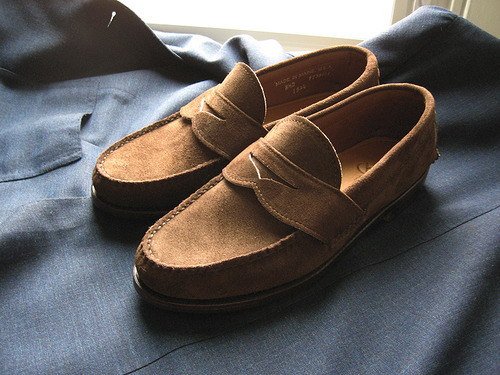
Everyone seems to want things custom-made these days, but there’s an advantage to ready-made that’s rarely talked about. With ready-made, you can more easily see what you’re getting before you pay for it. I was reminded of this when I recently received a pair of made-to-order loafers from Rancourt. These are their pinch penny loafers – moccasin constructed, with a handsewn strap, hard leather bottom, and unlined leather uppers. The term “unlined” here is a bit of a misnomer, because few shoes are truly made without any lining. Like with neckties, “unlined” in footwear typically means there’s just less lining, not that there’s no lining at all.

To explain, well-made shoes often have a full leather liner built in, so that two layers of leather are joined together to form the upper. This gives the shoes more support and structure, so that they hold their shape better over time. I wanted an unlined shoe, however, to feel like Alden’s unlined penny loafers. Those are floppy, soft, and feel like slippers. Those who’ve worn them know how comfortable they are. The problem is that they have a skin stitched detailing at the toe, rather than a genuine moccasin stitch. This means a single piece of leather is pulled over the last, and then a “skin stitch” is made at the toe for decorative effect. A genuine handsewn, on the other hand, is made with at least two pieces of leather – one forming the sides of the upper, and another for the vamp – with a handsewn saddle stitch to join everything together. That’s the moccasin style Maine producers are known for, and to my eye looks more pleasing for such a casual style shoe.

I told Rancourt I wanted something unlined so that it would be floppy and soft like Alden’s model, so they recommended their Orion suede leather. But when the shoes arrived, they weren’t floppy at all. “Unlined,” to be sure, but they’re soft in the way that any “unlined” boat shoes or camp mocs would be. It was a bit of a let down.

Still, they’re nice shoes, and appreciably more American than my English loafers. I think I’ll enjoy wearing them this spring with oxford cloth button down shirts, cotton trousers, and Shetland sweaters. It’s just unfortunate they’re not that floppy. 

Keep reading

Irish Wheat

image

I realized sometime last year that my wardrobe is sorely lacking in good dress coats. They’re harder to find now that fewer and fewer men wear tailored clothing, but they do exist. You can find them in traditional shops such as O’Connell’s and some more modern ones such as Brooks Brothers. You can also go vintage, which is an especially good option given how well coats tend to hold up (and how much money can be saved between buying a new vs. used). The third option is to get something custom made, which is what I’m hoping to have done. 

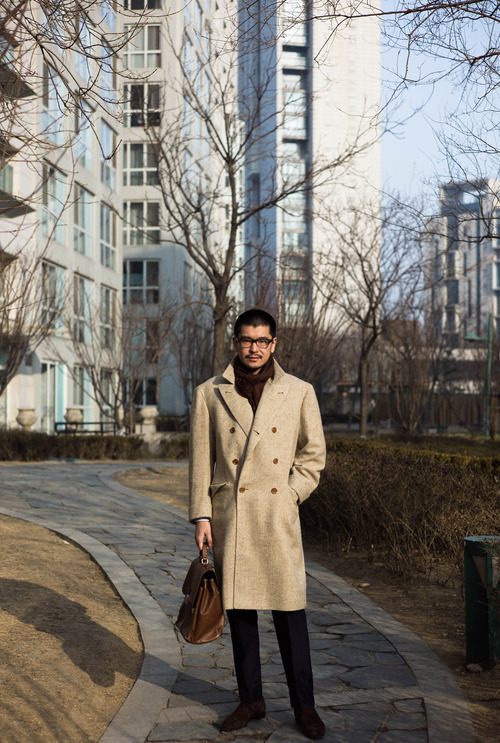
On my wish list is a deep navy Guard’s coat, which I plan to use for formal occasions; a traditional camel-colored Polo, which will less formal; and a tweed Polo, which less formal still. I fell in love with the idea of a tweed Polo after seeing Michael Alden in one here and here. (Michael has disallowed the embedding of his videos, but his coat is fantastic, so you ought to click through). Beijing1980 also commissioned something similar last year, which you can see in the photos above and below. Both are truly magnificent. 

Thus far, I’ve bought my fabric: a 21oz herringbone tweed that looks like the crust of a freshly baked loaf of bread (perhaps the crust that will protect my ever-expanding, soft, doughy belly?). It was woven by Molloy & Sons, a small woolen mill located in Donegal, which as many readers know, is a mountainous county in the northwest coast of Ireland. Donegal is famous for textile production, but the number of mills has dramatically declined over the years. Molloy & Sons is one of the few remaining, and is run by a father-and-son team (literally Molloy & his son). Everything is done by them in-house, except the finishing, and the workshop is located right next to the family’s home, where generations of Molloys have grown up. 

Despite being small and new, Molloy & Sons produces pretty exceptional fabrics. The one I have is hefty, but soft, and has a nice, springy bounce when you pinch the material and roll it between your two fingers. Like other Donegal tweeds, their fabrics are valued for the many, irregular flecks of color that decorate the surface. As Jesse wrote at Put This On, these are produced by washing and felting small bits of wool before the materials are spun into yarn. Because these bits are felted, they don’t stretch out, so they “glob onto the yarn like bubble gum on a piano string.” The result is a fabric with tons of earthy character, which makes it perfect for a fall/ winter garment. 

Keep reading

The Not-So-Basic Basic Wardrobe

image


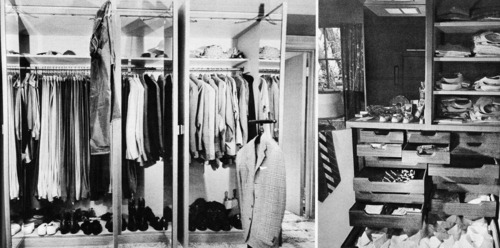
There must be hundreds, if not thousands, of lists at this point on how to build a basic wardrobe. Most are meant for people who are just starting out, so they include very basic things such as a blue blazer, a dozen dress shirts, two pairs of dress shoes, and a couple of grey trousers. Helpful if you’re still being introduced to this topic, but not terribly useful if you’ve been interested in clothes for a while. 

There are a few exceptions. Here are three, written by men who have a lot to say on the subject of classic men’s dress. Be forewarned: this is not a short post, and these are not short lists. These are also meant for men who are either interested in clothes or have significant means. I think they’re enjoyable to read, so long as you take them for what they are.

Michael Alden

The first comes from Michael Alden, who has posted a couple of these lists at The London Lounge. The first delineates his version of a minimalistic wardrobe.

Keep reading